What happens to your business’s technology when the one person who understands it is sick, away, or already handling an urgent problem? A solo IT professional may be skilled and dependable, but the risks of using a one-man IT shop come from relying on one person for support, security, backups, and critical systems knowledge. If that person is unavailable or overloaded, your team may wait for help and routine IT work may fall behind.
You don’t have to assume every solo provider is unreliable to take continuity seriously. Assess how support, security, documentation, and recovery work when demand exceeds one person’s capacity. This guide explains what to look for, how to reduce dependence, and how a team-based managed IT relationship can share ongoing responsibilities across support, cybersecurity, and recovery planning.
Key Takeaways
- The risks of using a one-man IT shop come from concentrated responsibility, not necessarily a lack of skill. Find out how support continues when the sole technician is unavailable.
- Assess coverage, escalation plans, security practices, backups, and whether critical system knowledge is documented and accessible.
- Review support, cybersecurity, and recovery separately to identify where one person’s capacity may be stretched and which safeguards matter most to your business.
- Compare individual support with a team-based managed IT model by considering how ongoing responsibilities are shared and maintained.
Risks of Using a One-Man IT Shop: Where Single-Person Dependency Creates Exposure
The risks of using a one-man IT shop come from concentrated responsibility, not automatically from a lack of technical skill. A capable solo technician may know your systems well and provide dependable support. The business exposure appears when essential work depends on that person being available, having enough time, and holding the information needed to act.
When one person is responsible for IT, a gap in their availability or capacity can become a gap in support for the whole business. Assess that continuity risk without making assumptions about the individual provider.
How one-person dependency can affect daily operations
Picture a Raleigh employee who cannot access a shared file while the technician is troubleshooting a network issue elsewhere. A routine account request and planned maintenance may have to wait. When multiple needs compete for one person’s attention, even manageable issues can cause delays, and preventive work may keep getting pushed back.
System knowledge matters, too. If network configurations, account access procedures, vendor contacts, or recovery instructions are undocumented or unavailable to anyone else, another qualified person may struggle to take over during an absence. That’s a single point of failure: dependence on one element can leave a larger system vulnerable when that element isn’t available.
Support needs can grow as a business adds employees, devices, cloud tools, or security responsibilities. A solo provider may have safeguards such as clear documentation and backup coverage, so headcount alone doesn’t tell the whole story. Focus on whether critical work can continue and whether another authorized person can access the information needed to support it. These are practical signs of resilience, and you can assess them systematically.
How to Assess a One-Man IT Shop: A Practical Continuity and Security Checklist
Use these questions to assess the safeguards behind the support relationship, not just the technician’s individual skills. Look for specific processes and records that show essential IT work can continue during absences, busy periods, or simultaneous problems.
Can someone else access the documentation, respond to support needs, and restore critical systems if the primary technician is unavailable? Every business should have clear answers to these continuity questions.
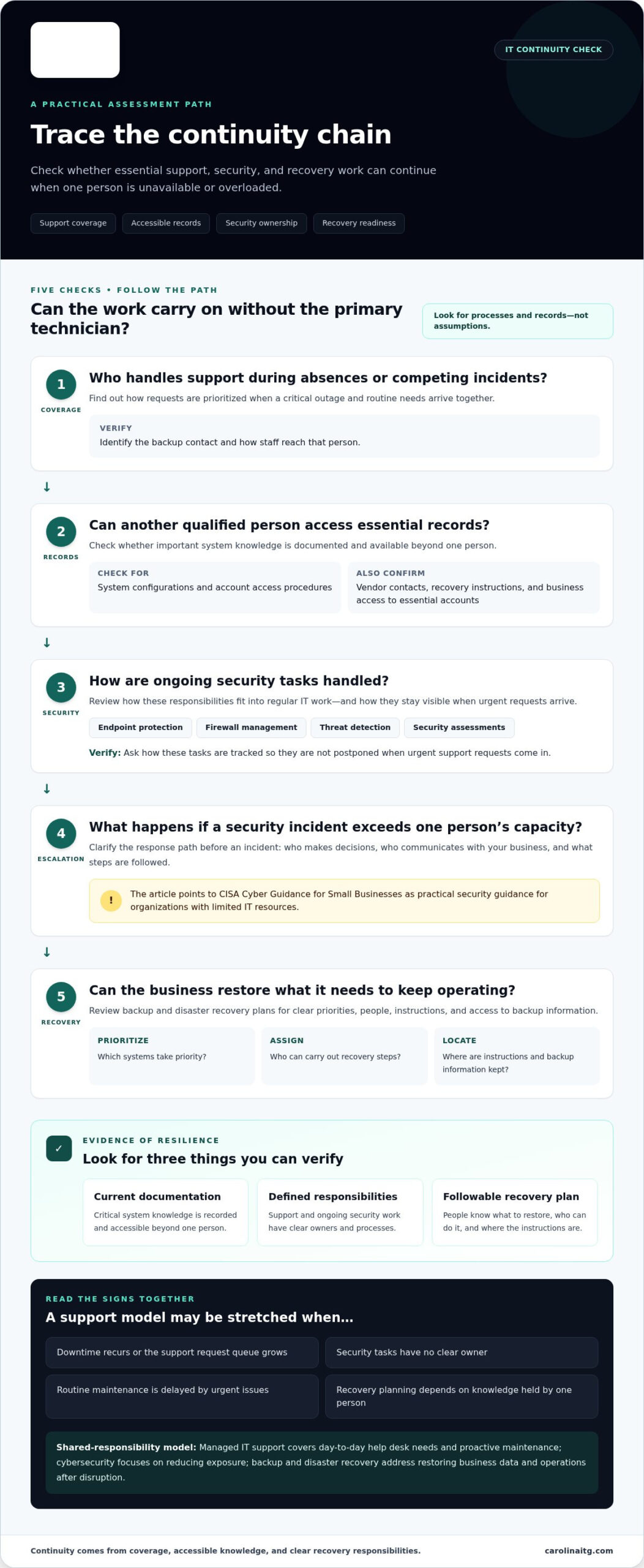
Five questions that reveal whether IT support is resilient
- Who handles support during absences or competing incidents? Find out how requests are prioritized when a critical outage and routine needs arise at the same time. Identify the backup contact and how staff reach that person.
- Can another qualified person access essential records? Check whether system configurations, account access procedures, vendor contacts, and recovery instructions are documented and securely available beyond one person. Confirm that the business retains access to its essential accounts.
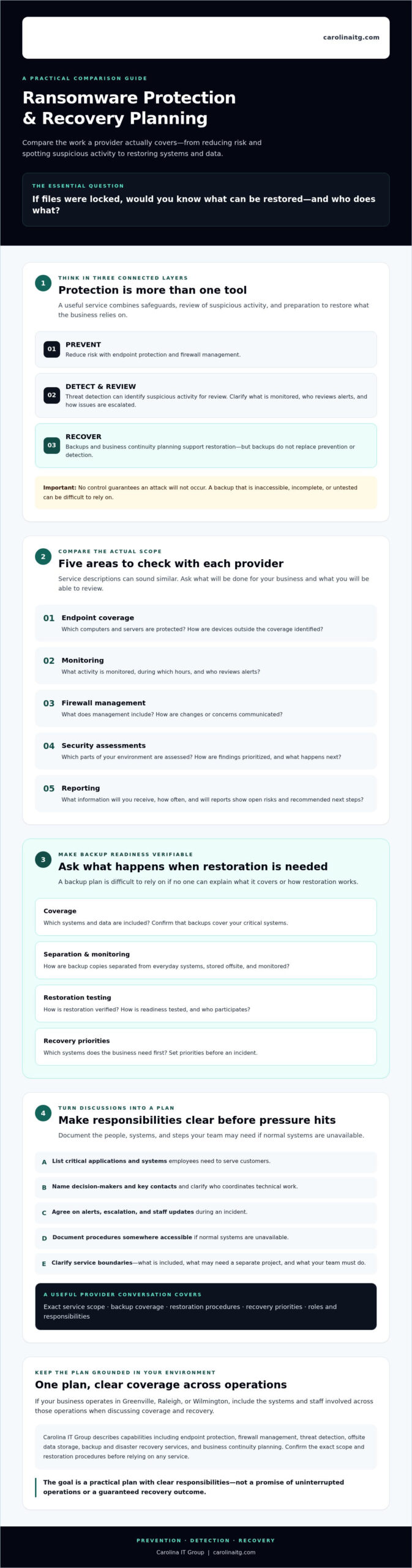
- How are security tasks handled on an ongoing basis? Review how endpoint protection, firewall management, threat detection, and security assessments fit into regular IT work. Ask how these tasks are tracked so they don’t get postponed whenever urgent support requests come in.
- What happens if a security incident needs escalation? Identify who makes decisions, who communicates with your business, and what steps are followed if the incident exceeds one person’s capacity. The CISA Cyber Guidance for Small Businesses offers practical security guidance for organizations with limited IT resources.
- Can the business restore what it needs to keep operating? Review backup and disaster recovery plans, including which systems take priority, who can carry out recovery steps, and how restoration supports business continuity. Make sure the plan explains where recovery instructions and backup information are kept.
The risks of using a one-man IT shop are easier to evaluate when you look for evidence: current documentation, defined responsibilities, and a recovery plan people can follow. A conversation about your IT continuity needs can help you identify which safeguards matter most for your business.
Reduce IT Support Risk with a Team-Based Managed Services Model
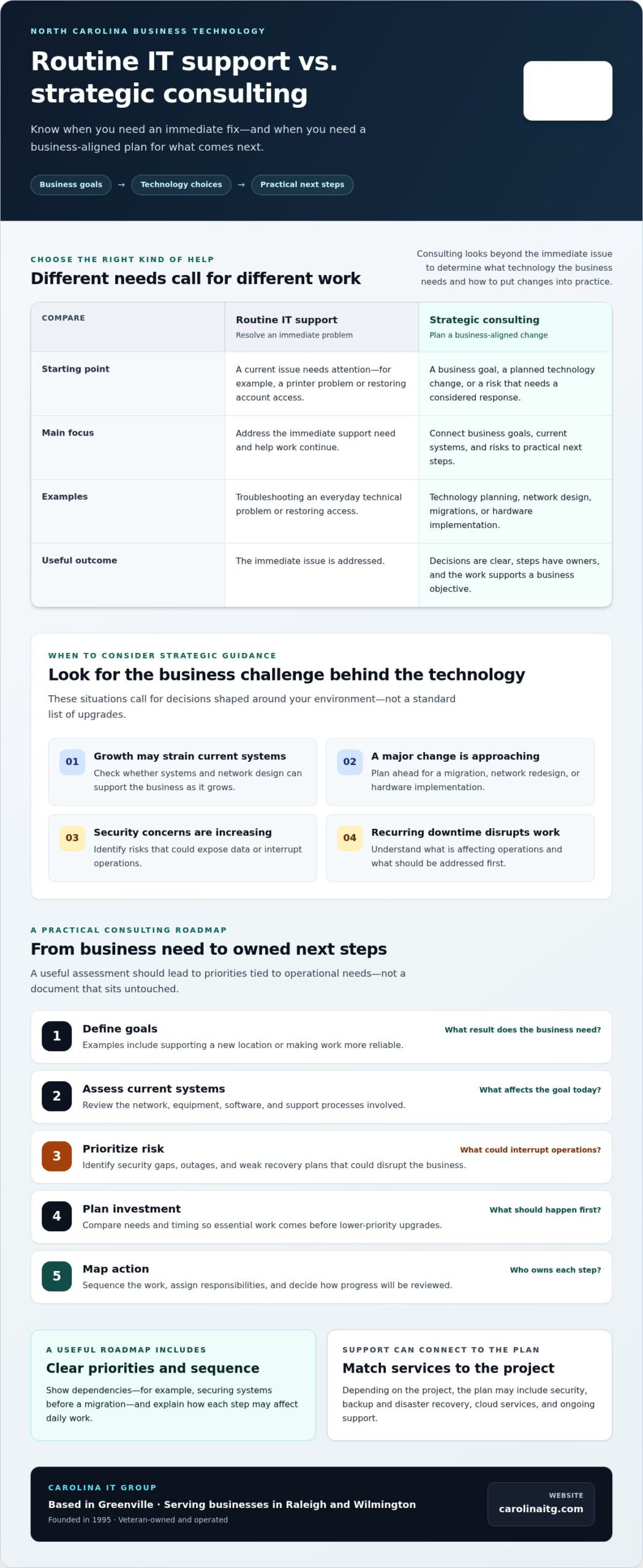
A team-based managed IT relationship can reduce reliance on one person by sharing support, security, and recovery responsibilities. The goal isn’t simply to have more technicians. It’s to clarify who owns each task, maintain consistent processes, and give your business a support model that can adapt as its needs change.
Each service addresses a different need. Managed IT support services cover day-to-day help desk needs and proactive maintenance. Cybersecurity focuses on reducing exposure through measures such as threat detection, firewall management, endpoint protection, and security assessments. Backup and disaster recovery address how business data and operations can be restored after a disruption. Together, these functions give support, protection, and recovery clear roles instead of leaving them all to compete for one person’s time.
When should a business consider managed IT support?
Recurring downtime, a growing queue of support requests, or security tasks with no clear owner can signal that your current model is stretched. Notice whether routine maintenance gets delayed whenever urgent issues arise, or whether recovery planning depends on knowledge held by one person. These patterns may point to a need for broader coverage and defined responsibilities.
Managed IT security gives cybersecurity work a defined place alongside daily support. Carolina IT Group provides managed IT services, cybersecurity, and backup and disaster recovery for businesses in Greenville, Raleigh, and Wilmington, North Carolina. If you’re weighing the risks of using a one-man IT shop against a shared support model, discuss your IT needs with Carolina IT Group and identify the responsibilities your business needs covered.
Build a Support Model That Can Grow With Your Business
Your IT support model should fit not only the systems you have today, but also the demands your business expects to take on next. The risks of using a one-man IT shop are a useful prompt to look beyond who fixes a problem and consider how technology responsibilities will stay covered as your team, tools, and priorities change. A resilient approach makes ownership of support and protection clear, so your business can focus on its work.
Carolina IT Group is veteran-owned and operated and was founded in 1995. Its managed IT, cybersecurity, and backup and disaster recovery services help businesses in Greenville, Raleigh, and Wilmington, North Carolina, plan support around their needs. Take the next step with a practical conversation about the coverage your business needs and the support model that fits. Talk with Carolina IT Group about your IT support needs.
Frequently Asked Questions
Is a one-man IT shop always risky for a small business?
No. A solo IT professional can be a good fit when the support arrangement matches the business’s needs and has clear processes for coverage, security, and recovery. The risks of using a one-man IT shop depend less on headcount alone than on what happens when demand exceeds one person’s capacity. Reassess the arrangement as your business grows and its support needs change.
What happens if the only IT person is unavailable during an emergency?
The response depends on the arrangements already in place. Without a backup contact or a clear escalation path, staff may not know who can coordinate a response, communicate with vendors, or make time-sensitive decisions. For example, a business could lose access to an essential cloud service while waiting for direction. Agree in advance on who can make operational decisions during an IT incident.
Can a one-person IT provider support cybersecurity and backups?
Yes, if the work is organized and maintained consistently. A provider may handle security protections and backup planning, but your business should understand how those tasks are reviewed and how recovery is carried out. For example, make sure there is a clear process for confirming that essential files can be restored, rather than relying only on a record that backups ran.
How can a small business reduce dependence on one IT person?
Keep key technology accounts under business ownership, assign an internal decision-maker, and maintain a current inventory of essential systems and vendors. Then test the handoff: could another qualified person identify what needs attention and who has authority to act? This exercise can help small businesses in Raleigh, Greenville, and Wilmington spot gaps before a disruption puts the process to the test.