A North Carolina business shouldn’t assume it’s exempt from CMMC because of its size or location. Requirements depend on the contract and the type of information involved. CMMC compliance services in North Carolina can help determine what applies and prepare your systems and records.
It’s reasonable to want a clear answer before investing time in compliance, especially when contract language and security requirements are difficult to interpret. This guide explains how to assess whether CMMC applies, what readiness and gap assessments examine, and how remediation and evidence collection support preparation.
You’ll also learn how FCI and CUI affect the work involved and what to consider when planning next steps. The goal is practical clarity: focus on the requirements tied to your contracts rather than assuming a waiver applies.
Key Takeaways
- Use your DoD contract terms and the information your organization handles to identify which CMMC requirements may apply.
- A readiness assessment can reveal gaps between current security practices and the requirements tied to your work.
- Plan remediation and organize supporting evidence so your assessment preparation is grounded in documented security practices.
- Managed IT and cybersecurity support can help address technical gaps; the right next step depends on your contract scope and assessment needs.
CMMC readiness and gap assessments
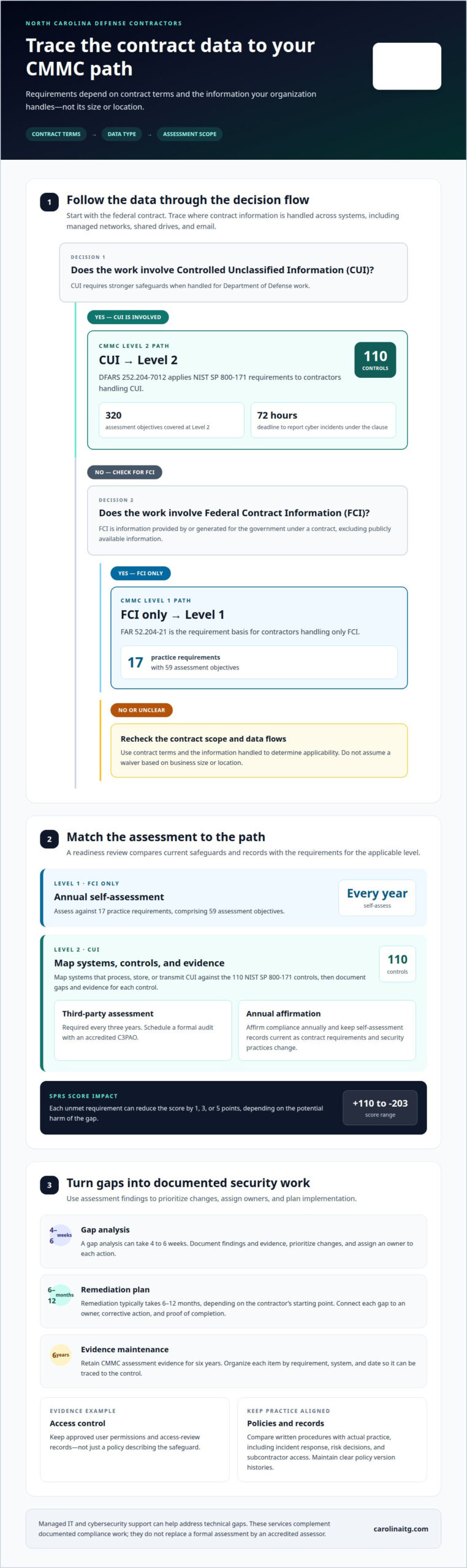
Start with the federal contract and identify whether your organization handles Federal Contract Information or Controlled Unclassified Information. That scope helps determine the CMMC level, assessment path, and security work to plan.
Readiness and Gap Reviews
A readiness review compares current safeguards and records with the requirements for the applicable CMMC level. For Level 2, map systems that process, store, or transmit CUI against the 110 NIST SP 800-171 controls, then document gaps and evidence for each control.
A gap analysis can take 4 to 6 weeks. Use its findings to prioritize changes, assign owners, and plan how to implement missing safeguards. For North Carolina organizations, managed IT support services can help align system operations with documented security practices.
SPRS Scoring and Assessment Levels
Level 1 organizations self-assess annually against 17 practice requirements, comprising 59 assessment objectives. Level 2 covers 110 NIST SP 800-171 controls and 320 assessment objectives. Each unmet requirement can reduce the SPRS score by 1, 3, or 5 points, depending on the potential harm of the gap; the score ranges from +110 to -203.
Level 2 also requires a third-party assessment every three years and an annual affirmation of compliance. Prepare by organizing evidence and resolving gaps before scheduling a formal audit with an accredited C3PAO. Select an assessor based on accreditation and fit with your assessment scope, then coordinate the audit timeline. Keep self-assessment records current as contract requirements and security practices change.
Federal Contract Information and Controlled Unclassified Information
For defense contractors in North Carolina, applicability depends on contract terms and the information their systems handle. Federal Contract Information (FCI) is information provided by or generated for the government under a contract, excluding publicly available information. Controlled Unclassified Information (CUI) requires stronger safeguards when handled for Department of Defense work.
Contractors handling only FCI fall under Level 1, with FAR 52.204-21 as the requirement basis. Contractors handling CUI are subject to NIST SP 800-171 requirements through DFARS 252.204-7012. That clause also requires covered contractors to report cyber incidents within 72 hours. Prime contractors and subcontractors should trace where contract data moves, including managed network environments, shared drives, and email.
Which North Carolina firms provide CMMC consulting, assessment, and remediation? Cybersecurity and compliance firms can support readiness reviews and remediation, while formal assessments must be scheduled with accredited C3PAOs. The right scope depends on whether the work involves FCI, CUI, or both.
What risks and penalties can North Carolina businesses face for failing to meet CMMC requirements? Gaps can put contract eligibility at risk, while inaccurate cybersecurity-score reporting can have serious financial consequences.
Are there North Carolina grants or programs to help small businesses pay for CMMC compliance? Don’t assume funding is available or covers compliance work. Review each state or federal program’s eligibility rules and permitted expenses before including funding in your compliance plan.
For practical help mapping contract data to security work, discuss your compliance needs with the team.
Gap analysis, remediation, and evidence collection
A documented gap analysis turns readiness findings into assigned security tasks. Track each remediation item alongside the evidence showing how it was resolved.
Managed Compliance and Evidence Maintenance
Remediation typically takes 6-12 months, depending on a contractor’s starting point. Build a work plan that connects each gap to an owner, corrective action, and proof of completion. Defense contractors should revisit that plan as systems, staff, and subcontractor access change. Ongoing evidence maintenance keeps records aligned with actual security practices, rather than leaving a last-minute scramble before certification.
Certification Evidence Collection
Collect records showing how each safeguard works, not just that a policy exists. For example, access-control evidence may include approved user permissions and access-review records. Organize each item by requirement, system, and date, and make it easy to trace the evidence to the control. Companies must retain CMMC assessment evidence for six years.
Policies and Documentation
Policies should describe the security practices people follow when handling government information. Compare written procedures with what happens in practice, including incident response, risk decisions, and subcontractor access. If a DFARS clause applies, keep related procedures and supporting records together. Clear version histories help show which policy was active and when staff received updates.
Use a gap analysis to prioritize remediation and build an evidence plan that fits your systems. Discuss CMMC remediation and evidence needs to plan practical next steps.
Carolina IT Group: Managed IT Services
Carolina IT Group supports North Carolina businesses with technology and security practices that can contribute to CMMC readiness. Its Managed IT Services and Cybersecurity support day-to-day system management and help address technical gaps identified during readiness work.
When security changes affect how your team handles contract information, consistent support can help keep systems, safeguards, and operating practices aligned. Backup and Disaster Recovery and Cloud Services can also help protect business data and support its availability. These services complement documented compliance work but do not replace a formal CMMC assessment by an accredited assessor.
For support tailored to your organization’s systems and compliance priorities, contact Carolina IT Group.
Make compliance part of daily operations
CMMC readiness works best as an ongoing business practice, not a project that ends after an assessment. Assign clear ownership of security tasks, keep procedures aligned with how your team works, and include compliance responsibilities in routine technology decisions.
For organizations building this approach, CMMC compliance services in North Carolina can connect technical improvements with practical oversight. Carolina IT Group offers Managed IT Services, Cybersecurity, and Backup and Disaster Recovery to support system management and data protection as your needs evolve.
Start a conversation about the systems and compliance priorities your organization needs to address. Contact Carolina IT Group to discuss a practical next step. Clear ownership and steady progress can make the path ahead feel manageable.
Frequently Asked Questions
Can an organization be exempt from CMMC requirements or receive a waiver?
Don’t assume your organization is exempt or has a waiver simply because it’s small or operates outside a major defense hub. Applicability depends on contract requirements and whether your work involves FCI or CUI. CMMC compliance services in North Carolina can help map contract clauses to the information your organization and subcontractors handle, clarifying which requirements apply to your work.
Can you help North Carolina businesses with NIST 800-171 and DFARS 7012 on top of CMMC?
Yes. Carolina IT Group offers Compliance Services to support North Carolina businesses addressing related cybersecurity requirements, including NIST SP 800-171 and DFARS 252.204-7012. CMMC compliance services in North Carolina can connect contract obligations with the systems and security practices used to handle covered information. The work should be scoped around the clauses and data relevant to your contracts.
Do CMMC services include SSP and POA&M documentation?
Documentation can include both an SSP and a POA&M. An SSP describes the system boundary and safeguards in place; a POA&M records gaps and planned corrective actions. Tie each entry to the systems and practices it concerns so internal teams can track implementation and explain the records during an assessment.
Do I need a C3PAO or an RPO to get certified?
For a formal Level 2 certification assessment, schedule the audit with an accredited C3PAO. An RPO may support preparation, but it isn’t the organization that conducts that certification assessment. If your contract calls for a self-assessment instead, follow that route and maintain the required records. Choose the path based on the assessment type your contract requires.
Do subcontractors need CMMC?
Subcontractors may need to meet CMMC requirements when their work involves FCI or CUI covered by a DoD contract. For example, a subcontractor receiving controlled technical files may have different obligations from one handling no covered contract information. Prime contractors should identify who receives the data, how it is shared, and which clauses flow down to each subcontract.

President & CEO
I hope you enjoyed this article. My mission is to take your stress away from dealing with IT problems. Call (252) 565-1235 or send me a message at our contact us page if you have a question, comment or want help.