
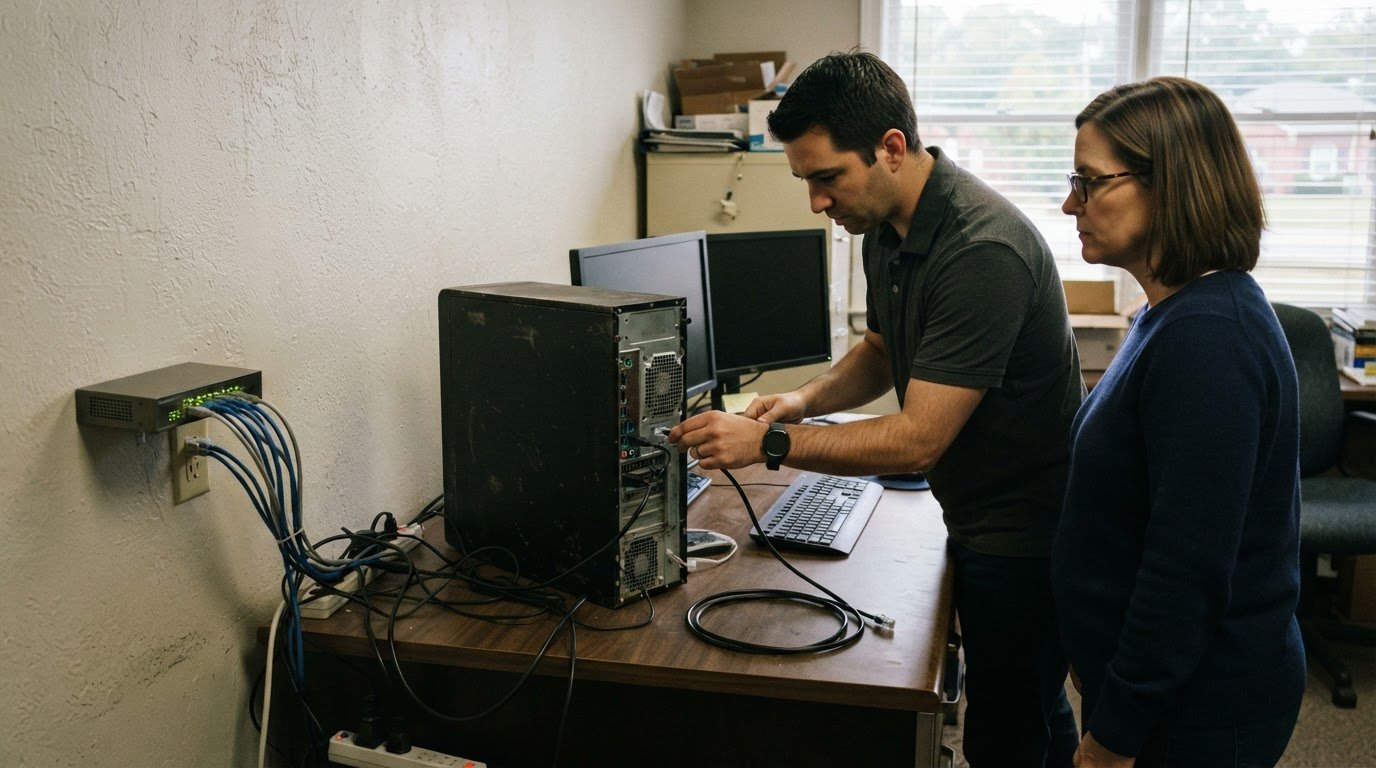



A security operations center (SOC) monitors an organization’s IT infrastructure around the clock, 24/7/365, to detect and investigate potential threats. For North Carolina organizations, security operations center (SOC) services bring monitoring and incident response into a coordinated security function, helping teams understand what’s happening and what needs attention.
Cybersecurity tools are more effective when alerts are considered together and linked to a clear response. This article explains what a security operations center (SOC) does, how monitoring and incident response work, and how coordinated security operations connect information across systems. You’ll learn how this broader view can help organizations assess alerts, investigate suspicious activity, and respond with greater clarity.
Key Takeaways
- Understand how a SOC monitors IT systems continuously and why that visibility matters for spotting suspicious activity.
- Learn how security teams assess alerts, investigate potential incidents, and coordinate a response.
- See how unified security operations connect information across tools to give teams a clearer view of risk.
- Recognize when managed IT services, cybersecurity, and backup and disaster recovery can support your organization’s security needs.
SOC incident monitoring, analysis, and response
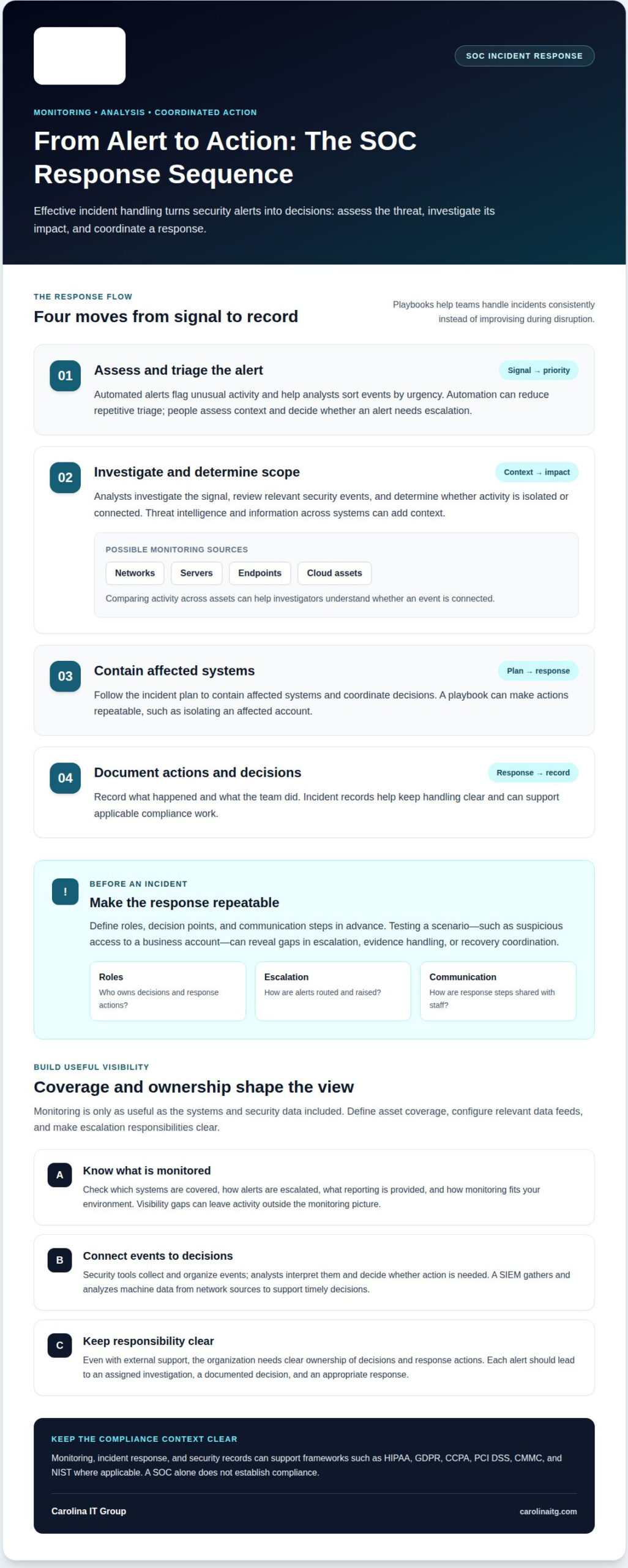
Effective incident handling turns alerts into decisions: assess the threat, investigate its impact, and coordinate a response.
SOC Processes and Incident Playbooks
SOC processes define how analysts assess, escalate, investigate, and document a security incident. Playbooks turn those steps into repeatable actions, such as isolating an affected account and recording what happened. For North Carolina businesses, relevant threats and compliance needs depend on their systems and data; monitoring and records can support frameworks such as HIPAA, GDPR, CCPA, or PCI DSS where applicable. Clear procedures help teams act consistently rather than improvise during disruption.
Automated Alerts and Incident Handling
Automated alerts flag unusual activity across networks and help analysts sort events by urgency. Automation can reduce repetitive triage, while people investigate context and decide whether an alert needs escalation. SOC-as-a-Service uses an external team and shared processes; an in-house SOC relies on an organization’s own staff and infrastructure. In-house operations suit large enterprises with resources to maintain 24/7 coverage, while external services can provide access to monitoring without building the whole operation internally.
Incident Response Planning and Testing
Response planning assigns roles, decision points, and communication steps before a real incident occurs. Testing a scenario, such as suspicious access to a business account, helps reveal gaps in escalation, evidence handling, or recovery coordination. Onboarding with a managed SOC provider generally begins by identifying relevant systems and assets, then setting alert routes, responsibilities, and response procedures. A managed IT security approach can help connect monitoring with an organization’s wider security needs.
Threat Detection and Response
Threat detection combines security events, threat intelligence, and analyst review to identify activity that may put systems or assets at risk. The response then follows the incident plan: investigate the signal, determine its scope, contain affected systems, and document actions. For healthcare organizations, SOC teams can support HIPAA compliance through monitoring and incident records, according to the U.S. Department of Health and Human Services. Coordination helps teams link detection to practical response.
What is a security operations center (SOC)?
A SOC coordinates cybersecurity monitoring, analysis, and investigation across an organization’s digital environment. Its purpose is to connect security events to decisions, rather than leave alerts isolated in separate tools.
Continuous Security Monitoring
Continuous security monitoring reviews activity around the clock to identify suspicious changes and support incident response. It gives organizations visibility between scheduled reviews, including into unusual sign-ins or unexpected data transfers.
When assessing SOC capabilities, consider what systems are monitored, how alerts are escalated, what reporting is provided, and how the service fits your environment. Businesses in Greenville, Raleigh, and Wilmington should also understand how security concerns are communicated to internal staff. Even with outside support, the organization needs clear ownership of decisions and response actions.
Monitoring Networks and Other Assets
A SOC may monitor networks, servers, endpoints, and cloud assets to build a broader picture of risk. For instance, investigators can compare an unusual server connection with activity from a user’s device or cloud account. Reviewing activity across these assets helps determine whether an event is isolated or connected.
Monitoring coverage depends on which systems supply useful security data and how those feeds are configured. Gaps in visibility can leave activity outside the monitoring picture, so teams should define asset coverage and escalation responsibilities.
Security Monitoring, Analysis, and Tools
Security tools collect and organize events; analysts interpret them, investigate context, and decide whether action is needed. A security information and event management (SIEM) system gathers and analyzes machine data from network sources to support timely decisions.
For CMMC, NIST, or PCI DSS, monitoring, incident response, and security records can support broader compliance work; a SOC alone does not establish compliance. SOC processes should align with NIST SP 800-53, while SOC teams can help organizations manage PCI DSS compliance. To discuss how monitoring fits your environment, talk through your security needs.
Unified security operations
Unified security operations brings information from different tools and environments into a shared view. Rather than investigate network, email, and cloud events separately, analysts can connect related activity and understand its effect on the organization’s infrastructure.
Consider an account that receives a suspicious email, signs in from an unusual location, and accesses cloud files. Viewed separately, those events may seem unrelated. Unified capabilities help analysts connect the sequence, add context using threat intelligence, and assess whether it signals an attack. This broader view can help teams prioritize investigation and contain a threat before it affects more assets.
Integration is useful only when relevant sources provide usable information. Teams need to know which environments feed into monitoring, how events are organized, and who can act on findings. If a critical system falls outside that view, analysts may lack context. Clear responsibilities matter too: each alert should lead to an assigned investigation, a documented decision, and an appropriate response.
For North Carolina organizations, the practical takeaway is to treat security as a connected process, not just a collection of tools. Unified operations can bring monitoring, intelligence, and response workflows together while keeping internal staff and security analysts’ roles clear. Map critical assets and data flows, then identify where better visibility would help your team make decisions.
If disconnected security tools make it harder to understand threats across your environment, discuss your security needs and the systems that matter most.
Carolina IT Group
Carolina IT Group helps businesses in Greenville, Raleigh, and Wilmington connect day-to-day IT management with practical cybersecurity support. If you’re assessing SOC capabilities, begin by identifying which systems need visibility, how security concerns should reach the right people, and where your current defenses have gaps.
Managed IT Services and Cybersecurity can support a coordinated approach to protecting business systems. Cloud Services and Backup and Disaster Recovery can also address security and continuity needs. The right combination depends on your infrastructure, risks, and internal resources.
For help applying these considerations to your business, contact Carolina IT Group.
Make your next security decision practical
Turn security goals into decisions your team can act on: identify the business systems that matter most, assign response ownership, and determine how protection should support daily work. For organizations considering security operations center (SOC) services in NC, these priorities help shape an approach that fits real operations without adding unnecessary complexity.
Carolina IT Group can help businesses in Greenville, Raleigh, and Wilmington consider how Managed IT Services, Cybersecurity, and Backup and Disaster Recovery fit their broader technology and security needs. Discussing your environment and priorities is a practical way to identify next steps.
Talk with Carolina IT Group about your security needs and move forward with a plan that supports your business.
Frequently Asked Questions
What is a SOC?
A SOC is a security operations center, the function that coordinates an organization’s cybersecurity work. It brings people, procedures, and monitoring tools together so security events can be assessed and assigned. If an employee reports a suspicious message, for example, the SOC can help determine whether it signals a wider risk and who should handle it.
What is an SOC?
“SOC” stands for security operations center. “An SOC” is commonly used because the abbreviation begins with the sound “ess.” In conversation, SOC can refer to the team or the broader security operation, not necessarily a dedicated physical room.
Who needs a SOC?
Organizations that rely on sensitive information, connected systems, or dependable access to technology may benefit from SOC capabilities. A healthcare practice, for example, may need clearer oversight of systems handling patient information; a growing company may need support beyond its internal IT capacity. The right scope depends on business assets, risks, and available resources.
Who works in a SOC?
SOC teams commonly include security analysts who review alerts, investigate suspicious activity, and escalate concerns. More experienced analysts may examine complex incidents, while managers coordinate priorities and communication. Some operations also include people who connect security work with organizational and compliance needs. Team structures vary, but clear responsibility helps ensure alerts reach someone able to assess them.
What security operations center (SOC) services are available in North Carolina?
Organizations seeking security operations center (SOC) services in NC can look for capabilities such as security monitoring, threat investigation, and incident response. Carolina IT Group serves businesses in Greenville, Raleigh, and Wilmington with related Managed IT Services, Cybersecurity, Backup and Disaster Recovery, and Cloud Services. These offerings can support broader IT and security needs without implying a dedicated SOC service.

President & CEO
I hope you enjoyed this article. My mission is to take your stress away from dealing with IT problems. Call (252) 565-1235 or send me a message at our contact us page if you have a question, comment or want help.



Leave a Reply
You must be logged in to post a comment.