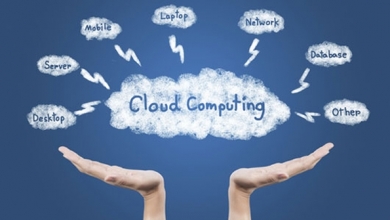
 What is cloud computing?
Cloud computing means storing and accessing data and programs over the Internet instead of your computer’s hard drive. With an online connection, cloud computing can be done anywhere and anytime.
We are always on the watch for the ‘next best thing’ when it comes to technology and the Internet. Certainly no one can doubt that the next generation of the Internet (known as Web 2.0) has had a dramatic affect on how people interact and connect with each other – both from an individual standpoint and a business one.
Another emerging concept that has the power to change how we perform tasks is taking place before us as well, and it is called ‘cloud computing.’ Simply put, it is the ability to use resources and tools via the Internet without actually owning or being near them. The only requirement is to be able to access them.
The term ‘cloud’ is used to indicate the whole of computing services accessible via the Internet. It is an all-encompassing description of the complex internet-connected networks that exist in data centers all over the world that power services and applications behind the scenes.
The concept of utilizing resources in these networks is being adopted by businesses both large and small. These resources are categorized to describe their function, and include:
Infrastructure as a Service (IaaS)
Platform as a Service (PaaS)
Software as a Service (SaaS)
Web 2.0
In the most general terms, Infrastructure as a Service means that companies may no longer need to own and house their own back-end servers and other network computing infrastructure besides an internet-connected PC or laptop in order to maintain business functionality. This capability can be purchased on a subscription basis from entities that market these services in a ‘virtual’ manner. This allows businesses to keep their costs low by not having to purchase, maintain and recycle their own equipment for this purpose, and also mitigates the possibility of business interruption due to the highly available nature of these solutions. This equates to increased uptime and profitability for Infrastructure as a Service customers.
Platform as a Service is also known as ‘cloudware’, and refers to the availability of development tools in creating web applications and services to the end user. Like IaaS, you never ‘see’ the inner-workings of this environment unless you are a computer programmer or IT resource, but it exists nonetheless and again affords those who use these tools the ability to reduce costs while running their businesses.
Sofware as a Service is defined as software applications that are subscribed to and accessed only through the Internet, and not installed on local PCs or laptops. Applications built by and accessed via Google fall into this category, as well as the many photo sites to which you can upload your pictures and videos, edit and share them with others. These solutions are gaining tremendous popularity, because end users do not need to install, update and maintain software locally – only connect to it and use it when the need arises.
Web 2.0 describes the whole of the social networking movement on the Internet, and includes but is not limited to destinations such as Facebook, MySpace, eHarmony, LinkedIn and Twitter. These sites offer the ability for people all over the world to share common interests, stay connected and learn more about each other – and these sites aren’t just for the young. Statistics show that the over 50 generation is logging onto these sites in greater numbers than ever before. In fact, in one month alone, Facebook adds over 17,000 new members.
The next time you are on the Internet and upload a photograph and use the online tools to modify that picture, you are participating in ‘cloud computing.’ The picture is probably loaded to a site that uses IaaS for their servers, PaaS in order to provide the visual interface in which you modify the photograph, and SaaS applications you’ll use to access your email program and social networking sites in order to send it to or post it for those with whom you would like to share the picture.

President & CEO
I hope you enjoyed this article. My mission is to take your stress away from dealing with IT problems. Call (252) 565-1235 or send me a message at our contact us page if you have a question, comment or want help.
 Last month, a new WiFi security vulnerability known as “Krack” was discovered by a security researcher named Mathy Vanhoef. It was about as serious as a security flaw could be, enabling hackers to clone a router and funnel traffic through it, either monitoring all the activity on the network or, if they wanted to be more destructive, conducting all manner of “man in the middle” attacks against anyone on the network.
 Facebook has been in hot water with evidence mounting that hordes of fake accounts were used to spread misinformation about the recent presidential election.
 Researchers at Rutgers University have hit upon a novel idea that could be a game-changer in terms of biometric identification. The team published a paper entitled “VibWrite: Towards Finger-input Authentication on Ubiquitous Surfaces via Physical Vibration,” and demonstrated a prototype of the device at the Association for Computing Machinery (ACM) conference in Dallas, Texas.
 You may not have heard of the new strain of ransomware known as BadRabbit. If you haven’t, it’s because the overwhelming percentage of BadRabbit attacks have been occurring in Russia, which accounts for 71 percent of all known infections at present. Unfortunately, there have been a few infections reported in the United States, which may be a harbinger of things to come.
 An Austrian software engineer named Felix Krause has made a disturbing discovery about iPhones using iOS11. Once an app has been given permission to access the device’s camera, it can take pictures and videos without alerting the user and upload them to the internet in real time.