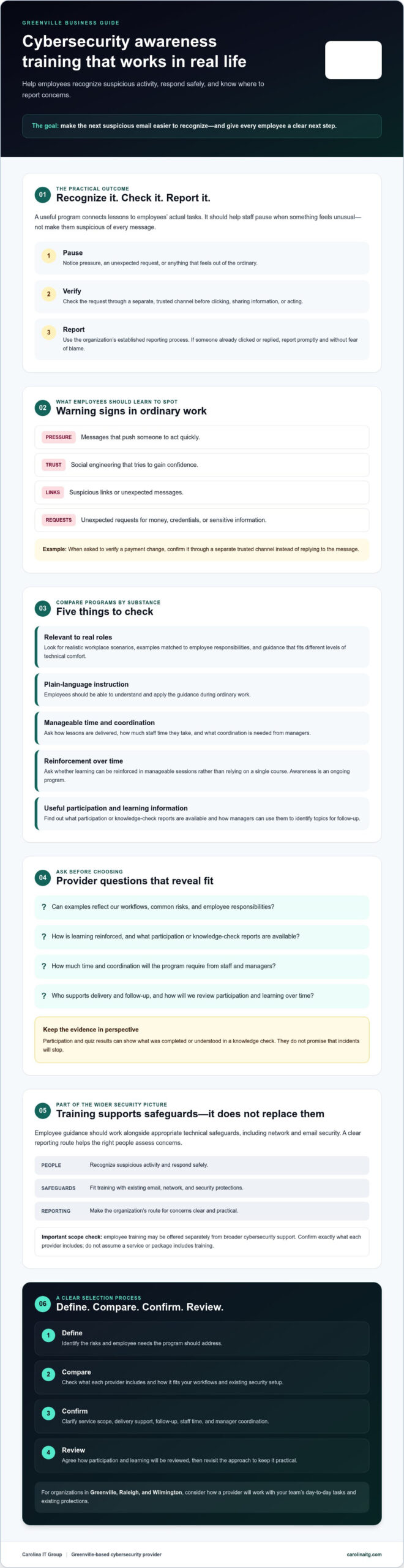
Employee cybersecurity training Wilmington businesses choose should help staff make safer decisions in everyday situations, not just pass a test or earn a technical certification. A course is only useful if employees can apply its guidance to the accounts, information, and requests they handle at work.
Training does not have to mean a long course that pulls employees away from their responsibilities. A practical program covers more than suspicious emails: it helps staff handle unexpected requests, protect company information, and report concerns through a clear channel. This guide explains how to compare training options, distinguish workforce awareness from technical certification, and reinforce learning over time. Businesses in Wilmington, Greenville, and Raleigh can also discuss how employee awareness fits into their broader security needs with a local technology provider such as Carolina IT Group.
Key Takeaways
- Employee cybersecurity training Wilmington businesses choose should reflect the risks and responsibilities employees encounter in their day-to-day roles.
- Use realistic workplace scenarios to help staff recognize unusual account requests and know how to report concerns.
- Assign someone to oversee the plan, and review participation and learning so the content stays relevant.
- Pair employee awareness with technical protections and incident procedures. Ask a local provider how its security services may support your broader needs.
Why Wilmington Businesses Need Employee Cybersecurity Training
Employee cybersecurity training helps staff recognize risks and follow safer routines while using workplace accounts, devices, and data. It goes beyond identifying suspicious emails. Employees also need to know how to protect login details, handle unexpected requests, and raise concerns through the right channel. For a general overview of common topics, see Security Awareness Training.
A stolen password can give someone access to company accounts. A mistaken click or response to an unusual request may expose information, interrupt work, and create demanding recovery tasks. Training cannot prevent every incident, but it can help employees make safer choices and report problems sooner. For Wilmington organizations, the goal is to prepare the workforce for risks tied to its actual work, rather than simply select the nearest class.
Employee awareness training or Security+ certification: which does your team need?
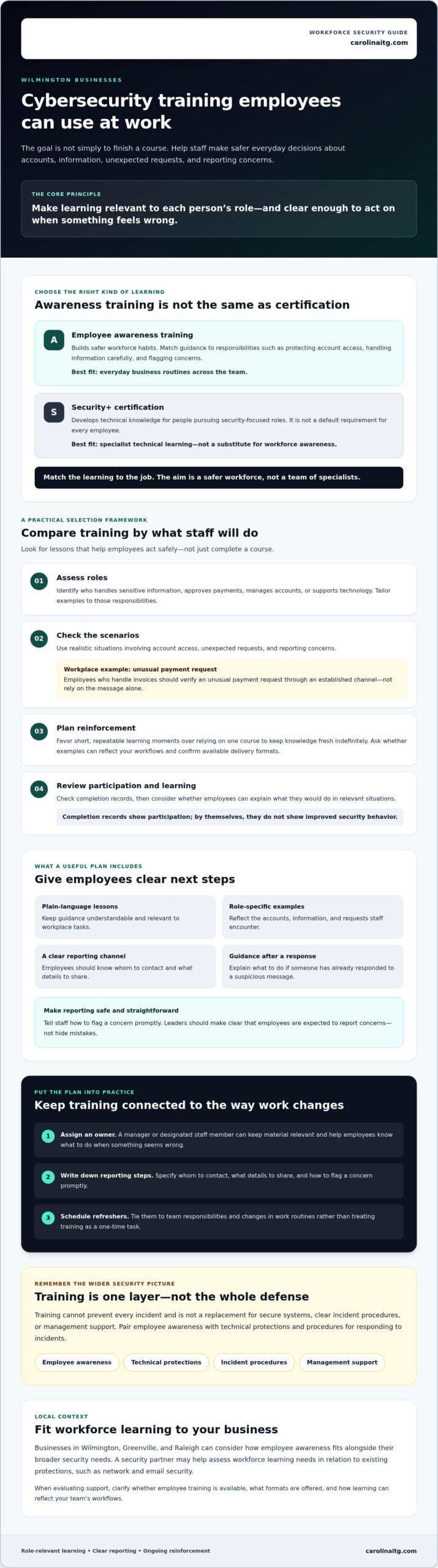
Awareness training builds workforce habits; certification develops specialist knowledge. Most staff need guidance that matches their responsibilities, such as protecting account access, handling information carefully, and flagging concerns. Security+ certification is intended for people developing technical knowledge for security-focused roles, not as a default requirement for every employee. Match learning to the job: the goal is a safer workforce, not a team of specialists. When comparing employee cybersecurity training Wilmington options, check whether the material addresses everyday business routines or focuses mainly on certification.
How to Choose Effective Employee Cybersecurity Training in Wilmington
Choose a program that fits how your team works, then check whether it helps employees act safely, not just complete a lesson. Use this framework to compare employee cybersecurity training Wilmington options:
- Assess roles. Identify who handles sensitive information, approves payments, manages accounts, or supports technology. Tailor guidance to those responsibilities instead of giving every employee the same examples.
- Check the scenarios. Look for realistic examples involving account access, unexpected requests, and reporting a concern. For instance, employees who handle invoices should know how to verify an unusual payment request through an established channel rather than relying on the message alone.
- Plan reinforcement. Favor short, repeatable learning moments over relying on one course to keep knowledge fresh indefinitely. Ask whether examples can reflect your workflows, and confirm which delivery formats are available before choosing a provider.
- Review participation and learning. Check completion records, then consider whether employees can explain what they would do in relevant situations. Completion records show participation, not by themselves improved security behavior.
What should a useful employee training plan include?
Look for plain-language lessons, role-specific examples, and a clear process for reporting suspected incidents. Employees should know whom to contact, what details to share, and what to do if they have already responded to a suspicious message. Clear instructions reduce guesswork when someone is under pressure. The NIST Small Business Cybersecurity Corner can help employers explore practical security guidance as they build a broader plan.
Before selecting a provider, ask how the material can reflect your workflows and how learning will be reinforced. Wilmington businesses can also discuss their cybersecurity needs with Carolina IT Group and confirm whether employee training support is available and in what formats.
Putting a Wilmington Employee Cybersecurity Training Plan into Practice
Make training part of your working security plan. Assign an owner, such as a manager or designated staff member, to keep the material relevant and ensure employees know what to do when something seems wrong. Write down the reporting steps: whom to contact, what details to share, and how to flag a concern promptly. Schedule refreshers around team responsibilities and changes in work routines instead of treating training as a one-time task.
Training is one layer of protection, not a replacement for secure systems, clear incident procedures, or management support. The Federal Trade Commission’s FTC cybersecurity guidance can help small businesses consider employee practices alongside broader protections. Leaders should make clear that staff are expected to report concerns promptly, not hide mistakes.
How can local IT support fit into employee training?
A security partner can help assess workforce learning needs alongside existing protections, such as network and email security, and identify where staff guidance should support those controls. Carolina IT Group provides managed cybersecurity services and lists Wilmington among its service-area cities. Businesses in Wilmington, Greenville, and Raleigh can ask whether employee training support is available and what formats, if any, may fit their teams. They can also discuss how cybersecurity services in Greenville or their own location align with their operations.
For a practical next step, Wilmington businesses can discuss their cybersecurity needs with Carolina IT Group and ask whether training support is available. The conversation can help connect employee awareness with the protections and procedures already in place.
Build Safer Habits Across Your Wilmington Team
Effective employee cybersecurity training Wilmington businesses can use is practical, role-aware, and reinforced over time. Give staff clear steps for handling concerns, assign someone to keep the plan on track, and treat training as one part of a broader security approach, not a substitute for technical protections or incident procedures.
Carolina IT Group was founded in 1995 and lists Wilmington among the North Carolina cities it serves. Its offerings include managed cybersecurity services and proactive technical support. Businesses in Wilmington, Greenville, and Raleigh can ask how those services may fit their existing protections and whether employee training support is available.
Discuss your team’s cybersecurity needs with Carolina IT Group to explore a practical next step toward safer workplace habits. Employees do not need to become security specialists to help protect business operations.
Frequently Asked Questions
What should employee cybersecurity training cover?
Employee cybersecurity training Wilmington businesses choose should cover practical actions employees can use in their roles. Include protecting account access, recognizing unusual requests, handling company information carefully, and reporting suspected incidents through a clear channel. Use examples that reflect actual workplace tasks so employees can connect the guidance to decisions they make instead of memorizing general rules.
How often should employees receive cybersecurity training?
There is no single schedule that fits every organization. Plan regular reinforcement so employees revisit key practices instead of relying on one session to stay memorable. Review guidance when job responsibilities, workplace tools, or security procedures change, and after an incident or near miss. Choose a cadence that supports consistent learning without unnecessarily disrupting work.
Is cybersecurity training required for every Wilmington business?
Not necessarily as a blanket requirement for every business. Whether training is required can depend on your industry, the information you handle, contractual commitments, and applicable rules. Do not assume the same requirements apply to every Wilmington employer. Review obligations relevant to your organization with a qualified compliance or legal professional, then use those requirements to guide your workforce security plan.
Is employee awareness training the same as Security+ certification?
No. Employee awareness training helps staff build everyday habits, such as protecting account access and reporting concerns. Security+ certification is technical study for people pursuing security-focused roles. Most employees do not need specialist-level certification to follow safer work routines. Choose learning that matches each person’s responsibilities, and reserve deeper technical preparation for roles that call for it.

President & CEO
I hope you enjoyed this article. My mission is to take your stress away from dealing with IT problems. Call (252) 565-1235 or send me a message at our contact us page if you have a question, comment or want help.