




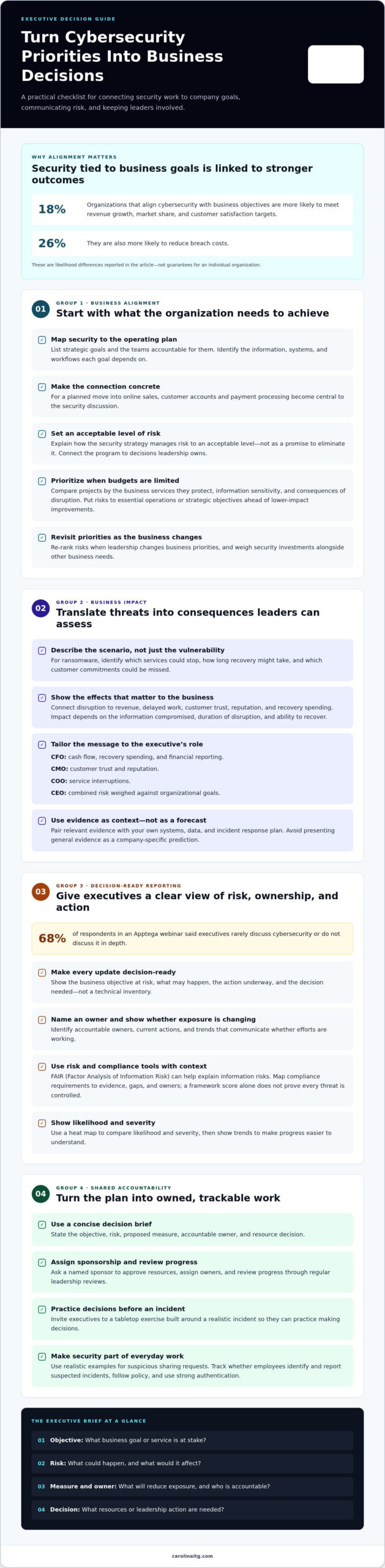
Organizations that align cybersecurity with business objectives are 18% more likely to meet revenue growth, market share, and customer satisfaction targets, and 26% more likely to reduce breach costs. Getting executive buy-in for cybersecurity starts with connecting security measures to business goals, explaining the potential impact in financial and operational terms, and giving leaders clear choices about risk and resources.
Executives want to understand what a security initiative protects and why it matters now. Technical detail alone rarely answers that; a clear explanation of business risk does. This article explains how to connect cybersecurity priorities to company strategy, describe potential financial, operational, and reputational consequences, and make risk reports useful to executives and board members. It also covers practical next steps, from assigning risk owners to tracking progress, so cybersecurity informs business decisions rather than remaining an IT-only conversation.
Key Takeaways
- Connect security priorities to business goals so leaders can weigh protection alongside revenue, operations, and reputation.
- Translate threats into potential financial and operational effects, then show what action could reduce exposure.
- Give executives clear, concise risk updates that identify the most important risks, who owns them, and what’s being done.
- Use practical measures such as tabletop exercises and progress tracking to turn cybersecurity from a technical topic into a shared business responsibility.
1. Aligning cybersecurity with business strategy
Start with the operating plan: list strategic goals and the teams accountable for them. For each goal, identify the information, systems, and workflows that need to remain available. For example, a planned expansion into online sales makes customer accounts and payment processing central to the security discussion. This ties protection to business execution instead of presenting it as an isolated technology request.
Getting executive buy-in for cybersecurity starts with showing how security choices reduce risks to business goals. A CISO should understand the organization’s risk appetite and explain how the security strategy manages risk to an acceptable level, rather than promising to eliminate it. The CEO ultimately bears much of the organization’s risk, so connect the program to decisions leadership owns.
Consider how employees work. If staff regularly handle confidential documents, use realistic examples of suspicious sharing requests and explain how to report them. Extend learning beyond annual training and quarterly phishing simulations. Track whether employees identify and report suspected incidents, follow policy, and use strong authentication.
When budgets are limited, compare projects by the business services they protect, the sensitivity of the information involved, and the consequences of disruption. Prioritize risks that could interrupt essential operations or impede strategic objectives over lower-impact improvements. Revisit the ranking when leadership changes business priorities.
A practical way to approach getting executive buy-in for cybersecurity is to present a concise decision brief: state the objective, risk, proposed measure, accountable owner, and resource decision. Regular leadership reviews can show progress and help executives weigh existing priorities against new ones. This makes security investments easier to assess alongside other business needs.
2. Communicating threats and vulnerabilities in financial terms
Translate each cyber threat into a business scenario executives can assess. For ransomware, identify which services could stop, how long recovery might take, and which customer commitments could be missed. Connect the disruption to revenue, delayed work, and reputation.
Tailor the message to each executive’s role. A CFO needs to understand potential effects on cash flow, recovery spending, and financial reporting. A CMO may focus on customer trust and reputation. The COO considers service interruptions, while the CEO weighs the combined risk against organizational goals. Give employees clear guidance on recognizable threats and how to report them.
Use evidence as context, not as a company-specific forecast. Best Buy Co., Inc. describes how compromised customer or confidential information could harm revenue and reputation and expose a company to costs, penalties, and claims. Pair relevant evidence with your own systems, data, and incident response plan.
Inadequate cybersecurity investment can leave threats unaddressed and increase exposure to disruption, response expenses, legal fees, penalties, claims, and lost customer confidence. The impact depends on the information compromised, how long operations are affected, and the organization’s capacity to recover.
Demonstrate the business case in a short risk brief. Describe the threat, business impact, proposed measure, owner, and decision needed. If leaders need help translating exposure into practical priorities, discussing cybersecurity priorities can help clarify next steps.
3. Explaining cybersecurity risks to executives and board members
Executives need a decision-ready view, not a technical inventory. According to an Apptega webinar, 68% of respondents said executives rarely discuss cybersecurity or don’t discuss it in depth. To engage leadership, show the business objective at risk, what may happen, and the decision needed. A concise risk report can identify owners, current actions, and whether exposure is improving.
FAIR, or Factor Analysis of Information Risk, helps cybersecurity leaders explain information risks in understandable terms. For compliance discussions, map relevant control requirements to evidence, gaps, and accountable owners. This gives executives a view of both risk and compliance without treating a framework score as proof that every threat is controlled.
Explain risk through a business scenario. For example, describe how compromised employee credentials could expose customer records, disrupt operations, or damage trust. State the likely business impact, the response underway, and the action that could reduce exposure. Use a heat map to compare likelihood and severity, then show trends to communicate whether efforts are working.
To secure sponsorship, connect the program to an executive objective. Present the priority risks, their business effects, and the measures needed to address them. Then ask a named sponsor to approve resources, assign owners, and review progress. Invite executives to a tabletop exercise so they can practice making decisions during a realistic incident. This turns technical concerns into a shared leadership responsibility.
Clear reporting makes cybersecurity objectives easier to discuss and act on. Discuss executive cybersecurity risk priorities to build a practical path from identified exposure to action.
Carolina IT Group: Managed IT Services
Carolina IT Group helps businesses put cybersecurity priorities into practice through Managed IT Services and Cybersecurity. Turn to the team when leadership needs help connecting technical risks with everyday business needs, or when security responsibilities compete with other IT demands.
For organizations concerned about disruption or data loss, Backup and Disaster Recovery can support recovery planning, while Cloud Services can address business needs involving cloud environments. Start with the risk your organization wants to address, such as protecting access, preparing for recovery, or strengthening oversight. Then connect cybersecurity work to operational priorities and executive decisions.
Contact Carolina IT Group to discuss your organization’s cybersecurity and IT priorities.
Turn Executive Support Into a Practical Next Step
Executive support matters most when it leads to clear ownership and consistent follow-through. As priorities shift, keep cybersecurity connected to the decisions leaders already make about operations, resilience, and customer trust. Getting executive buy-in for cybersecurity is an ongoing business conversation, not a one-time approval request.
Carolina IT Group helps businesses put those priorities into practice through Managed IT Services and Cybersecurity. When continuity planning is part of the discussion, Backup and Disaster Recovery can support preparedness for data loss or disruption. Start with a focused conversation about your organization’s needs, current concerns, and business objectives in Greenville, Raleigh, or Wilmington.
Contact Carolina IT Group to discuss your cybersecurity priorities, and take the next step toward a security program your leadership can support.
Frequently Asked Questions
What cybersecurity metrics and KPIs matter most to boards and executives?
Track measures that show whether risk is changing and whether employees can respond effectively. Useful indicators include how long it takes to identify and report suspected incidents, policy or audit violations, adoption of strong authentication, and progress across security domains. Pair each metric with its business meaning. For example, explain whether delayed incident reporting threatens customer service or business continuity.
How do you build a business case for cybersecurity investment with costs and ROI?
Build the case by comparing the investment with the business impact it aims to reduce. Define the affected operations, likely disruption, recovery needs, and potential consequences for customers or revenue. Then outline the proposed measures and how progress will be evaluated. Avoid promising a guaranteed return; show executives the assumptions behind the analysis and the options if priorities change.
What cybersecurity budget benchmarks do companies use by industry and company size?
There is no single useful benchmark for every organization. Budget needs depend on the sensitivity of the information handled, the systems that support essential work, compliance obligations, and the complexity of the technology environment. A smaller organization with critical customer data may need different protections from a larger business with simpler operations. Compare budget plans with documented risks and business priorities, not size alone.
How can CISOs align cybersecurity strategy with business goals?
CISOs can start with the current operating plan and identify the technology, information, and workflows each objective depends on. For example, a company expanding online services may need to prioritize account protection and service resilience. Review the security roadmap with business leaders as plans evolve, and adjust ownership and measures so protection supports current objectives.
What are effective ways to present cybersecurity risks to executive leadership?
Use a concise briefing that describes the scenario, business consequence, current response, and decision required. A risk heat map can help compare priorities, while a trend line can show whether exposure is improving. For a local business serving customers in Greenville, Raleigh, or Wilmington, connect the risk to the service or information customers rely on, then make the requested action clear.

President & CEO
I hope you enjoyed this article. My mission is to take your stress away from dealing with IT problems. Call (252) 565-1235 or send me a message at our contact us page if you have a question, comment or want help.



Leave a Reply
You must be logged in to post a comment.