Are recurring IT problems serious enough to justify replacing your provider, or could clearer expectations and a better support plan fix them? The signs you need a new IT provider usually aren’t one missed call or isolated outage. They show up as patterns: repeated disruptions, vague answers about security or backups, and costs that don’t match expectations. A practical review can help you decide what needs to change without making a rushed decision.
This checklist helps you distinguish a temporary setback from a persistent service gap. Review responsiveness, security, recovery planning, and cost communication, then compare what your business needs with the support you receive. If a change is needed, a structured handoff can help protect access to essential systems and reduce disruption for your staff and customers.
Key Takeaways
- Look for repeated service gaps, not just one frustrating incident, when assessing the signs you need a new IT provider.
- Compare what your provider agreed to deliver with what happens in practice, using ticket histories and other records.
- Check whether support, security oversight, and backup readiness meet your business needs.
- Before changing providers, map systems, access, open issues, and handoff responsibilities to support continuity.
Signs You Need a New IT Provider: Spot Persistent Service Gaps
A stalled support request or a disruptive outage can be frustrating, but one bad week doesn’t automatically mean it’s time to switch. Look for problems that recur, remain unresolved, and affect staff, customers, or daily operations. Managed services generally involve ongoing IT support and management, as outlined in Managed Services. The signs you need a new IT provider become more significant when the service you receive repeatedly falls short of your business’s needs.
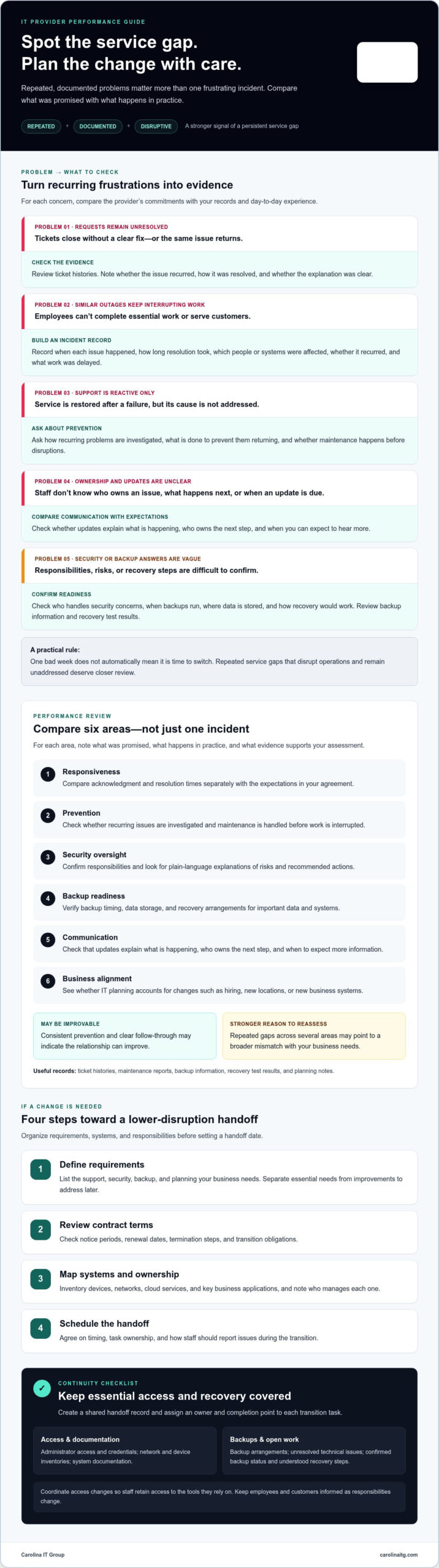
- Unresolved tickets: Requests are closed without a clear explanation or fix, or the same issue returns.
- Recurring outages: Similar disruptions repeatedly stop employees from serving customers or completing essential work.
- Reactive-only support: The provider restores service after a failure but doesn’t investigate or address its cause.
- Unclear ownership: Your staff don’t know who is handling an issue, what the next step is, or when they’ll receive an update.
- Weak communication: Explanations and follow-through are inconsistent, leaving you uncertain about risks, responsibilities, or next steps.
A provider red flag is a repeated, documented service gap that disrupts operations and remains unaddressed.
When is poor IT support a pattern rather than a bad week?
Keep an incident log rather than judging the relationship by one interaction. For each issue, record when it happened, how long it took to resolve, which people or systems were affected, whether it recurred, and what work was delayed. Compare the log with ticket histories and the response expectations in your agreement. This helps distinguish an isolated mistake from an ongoing problem and gives you specific examples for a performance discussion. Security and backup concerns deserve prompt attention when explanations are unclear or promised follow-through doesn’t happen. Carolina IT Group provides managed IT security services that include continuous protection, helping businesses take a proactive approach to reducing risk. Learn more about managed IT security services.
Use This Checklist to Compare Your IT Provider’s Performance
Turn general concerns into a practical review. For each area, note what your agreement or provider promised, what happens in practice, and what evidence supports your assessment. Useful records include ticket histories, maintenance reports, backup information, recovery test results, and planning notes. Looking across these records can show whether service gaps are isolated or point to a broader mismatch.
- Responsiveness: Are requests acknowledged and resolved within the expectations in your agreement? Track acknowledgment and resolution times separately.
- Prevention: Are recurring issues investigated and maintenance handled before problems interrupt work, or does support begin only after something breaks?
- Security oversight: Are responsibilities clear? Do you receive plain-language explanations of risks and recommended actions?
- Backup readiness: Can you confirm when backups run, where data is stored, and how recovery would work if important data or systems became unavailable?
- Communication: Do updates explain what is happening, who owns the next step, and when you can expect to hear more?
- Business alignment: Does IT planning account for changes such as hiring, new locations, or new business systems?
Which questions reveal whether IT support is proactive?
Ask how recurring problems are investigated and what steps are taken to prevent them from returning. Find out what systems and devices are monitored, who handles security concerns, how backup recovery is prepared, and how technology decisions support your business plans. Proactive IT support addresses risks before they become business interruptions. Carolina IT Group’s managed IT support services combine ongoing maintenance with help when issues arise.
Review the evidence across all these areas. Consistent prevention and clear follow-through may mean the relationship can improve. Repeated gaps across several areas may strengthen the signs you need a new IT provider. Businesses in Greenville, Raleigh, and Wilmington, North Carolina, can discuss their IT support needs with Carolina IT Group.
Plan a Low-Disruption IT Provider Change in North Carolina
Changing providers doesn’t have to mean a rushed cutover. Start by defining what your business needs, reviewing your current agreement, and organizing systems and responsibilities before setting a handoff date. Even when the signs you need a new IT provider are clear, a controlled plan helps protect access to essential systems and keeps employees and customers informed.
- Define requirements: List the support, security, backup, and planning your business needs. Separate essential needs from improvements you can address later.
- Review contract terms: Check notice periods, renewal dates, termination steps, and transition obligations.
- Map systems: Create an inventory of devices, networks, cloud services, key business applications, and who manages each one.
- Schedule the handoff: Agree on timing, task ownership, and how staff should report issues during the transition.
What should a continuity-focused handoff cover?
Build a shared record of administrator access and credentials, network and device inventories, system documentation, backup arrangements, and unresolved technical issues. Assign an owner and completion point to each transition task. Before responsibilities change, confirm backup status and make sure the recovery steps are understood. Coordinate access changes so staff don’t lose access to tools they rely on. Ongoing managed IT support can help keep technology maintenance and support aligned with daily business operations.
Carolina IT Group supports businesses in Greenville, Raleigh, and Wilmington, North Carolina. If you’re planning a provider change or reviewing your business’s IT needs, discuss your IT needs with our team.
Choose IT Support That Can Grow With Your Business
A provider change is an opportunity to set clearer expectations for how technology should support your business. If the signs you need a new IT provider point to a persistent mismatch, use your incident log and service review to define the outcomes you need and the safeguards a transition must protect. The goal isn’t simply to change providers. It’s to establish dependable support that fits your operations and future plans.
Carolina IT Group provides managed IT services, cybersecurity, backup and disaster recovery, cloud services, IT consulting, and VoIP solutions. Its managed services include 24/7 network infrastructure monitoring. Veteran-owned and operated by John Silverthorne, Carolina IT Group has supported businesses since 1995.
Talk with Carolina IT Group about your IT support needs and plan the next step for your business in Greenville, Raleigh, or Wilmington, North Carolina.
Frequently Asked Questions
How many signs should I see before changing IT providers?
There’s no set number. One unresolved security or backup risk may call for urgent attention, while several minor delays may be fixable. Use the signs you need a new IT provider as a prompt to assess how often problems occur, how much they affect the business, and whether agreed corrective steps work. If the same failure returns after a fix, weigh your options rather than waiting for an arbitrary count.
Can I change IT providers before my contract ends?
Your agreement’s terms determine your options. Review termination, renewal, notice, transition assistance, and data-return clauses. Ask a qualified legal adviser to interpret language you’re unsure about. Before giving notice, confirm the end date and how access, records, backups, and support responsibilities will be handled during any overlap. Avoid cancelling services until a continuity plan is ready.
How can I tell whether an IT problem is caused by my provider?
Look at where and when the problem occurs. An issue affecting one application or device may have a different cause from an outage affecting multiple systems or locations. Check whether a recent change, internet connection, or outside service is involved, and request a plain-language explanation of the cause. Then compare that explanation with the responsibilities set out in your agreement.
What should I do first if I am unhappy with my IT provider?
Raise the concern in writing and request a focused review of the issue causing the greatest disruption. Describe how it affects your work, explain what a satisfactory resolution would look like, and agree on a date to review progress. This gives both sides a clear opportunity to address the problem before you decide whether to change support for your business in Greenville, Raleigh, or Wilmington.

President & CEO
I hope you enjoyed this article. My mission is to take your stress away from dealing with IT problems. Call (252) 565-1235 or send me a message at our contact us page if you have a question, comment or want help.