What if a single line item in your 2026 budget could prevent a $4.88 million disaster? For many North Carolina business owners, technology spending feels like a black hole of “break-fix” invoices and unpredictable repair bills that disrupt your monthly cash flow. You’re likely tired of the financial whiplash that comes with emergency IT support. It’s frustrating when you can’t clearly justify cybersecurity costs to stakeholders, especially when the fear of a catastrophic data breach keeps you up at night. This guide will show you how to calculate the true ROI of managed IT services so you can stop guessing and start growing. We’ll walk through a step-by-step forecasting process to align your tech investments with your 2026 goals. You’ll learn how to secure a predictable monthly spend and gain total peace of mind for your Greenville, Raleigh, or Wilmington firm.
Key Takeaways
- Use the 2026 cross-industry benchmark of 5.5% of gross revenue to set a realistic baseline for your firm’s technology spending.
- Identify upcoming hardware lifecycles and hidden software costs before they cause operational downtime.
- Master how to calculate the ROI of managed IT services by comparing predictable monthly rates against the high costs of emergency repairs.
- Align your 2026 budget with growth goals while meeting strict HIPAA and PCI compliance standards.
Understanding IT Spending Benchmarks for 2026
Your 2026 IT budget isn’t just a repair fund. It’s the total sum of your hardware, software subscriptions, cloud services, and personnel costs. Most organizations use a cross-industry benchmark of approximately 5.5% of gross revenue as a starting point. This figure helps stabilize your financial planning, but it’s just the baseline. When you shift from reactive fixes to Managed services, you’re investing in a model that prioritizes uptime. Understanding the roi of managed it services starts with seeing your technology as a growth engine rather than a drain on resources.
For local North Carolina firms in healthcare or legal sectors, that 5.5% baseline often climbs higher. You face strict regulatory hurdles that require specialized IT compliance services NC businesses must maintain to avoid heavy fines. Protecting patient records or sensitive case files isn’t optional; it’s a core business requirement. We’ve seen how proactive monitoring prevents the downtime that costs NC firms thousands per minute.
2026 Industry-Specific Spend Variations
Professional service firms in Raleigh or Wilmington often need higher cybersecurity allocations. Data sensitivity in these hubs makes you a target. Small-to-mid-sized firms usually fall into two camps:
- Tech-Heavy: Businesses like engineering or architecture firms that rely on high-performance hardware and constant uptime.
- Tech-Dependent: Retail or service businesses that need reliable software for daily operations.
The roi of managed it services is most visible when these firms avoid the “Reactive Trap” of break-fix support. By planning for hardware lifecycles every 12 to 24 months, you ensure your Wilmington or Greenville office stays productive without surprise bills. This strategic approach keeps your growth goals on track while keeping your data safe.
A Step-by-Step Framework for Calculating Your IT Budget
Calculating a budget isn’t just about looking at last year’s receipts. It’s about looking forward. To get started, compare your current internal data against national IT spending benchmarks. This provides a baseline for where you stand.
First, audit your current technology stack and recurring subscription costs for managed IT support services. This identifies exactly what you’re paying for every month. Next, identify upcoming hardware lifecycles. If your servers are reaching the four-year mark, they’ll likely need replacement within the next 12 to 24 months. Finally, align these IT goals with your 2026 expansion plans in Raleigh or Wilmington. You don’t want your technology to be the bottleneck that stops you from hiring more staff or opening a new location.
Categorizing Fixed vs. Variable Technology Costs
Fixed costs include your monthly service fees and software licenses. These are predictable. You know exactly what’s leaving your bank account. Variable costs are the hidden killers of profitability. These include emergency repairs and sudden hardware failures that characterize the reactive ‘Break-Fix’ model. This unpredictability is what makes it difficult to see the true roi of managed it services when you’re constantly in a defensive position. By shifting these variables into fixed costs, you maximize the roi of managed it services through increased uptime and staff efficiency.
We suggest building a 10% contingency fund specifically for unexpected 2026 cybersecurity threats. Evolving threats mean a small buffer ensures you can respond without draining capital. If you’re ready to stabilize your spend, we can help you map out a predictable plan for the year ahead.
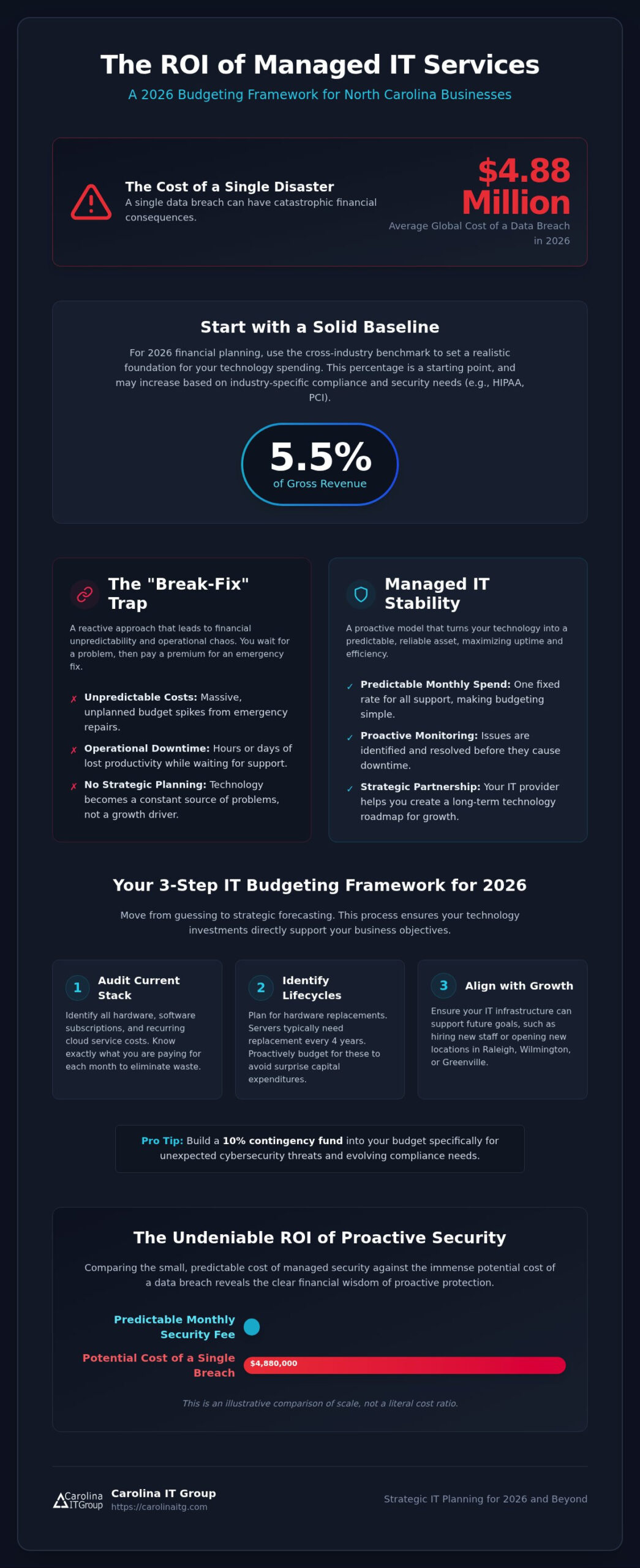
Strategic Budgeting: Moving from Reactive Costs to Managed IT Stability
The “Break-Fix” model is a financial trap that many North Carolina businesses fall into. You wait for something to break, then pay a premium for emergency repairs. This creates massive, unplanned budget spikes and hours of operational downtime. It’s hard to scale a business when you’re constantly putting out fires. Managed IT breaks this cycle. By providing a fixed monthly rate, it transforms your technology from a variable burden into a predictable asset. Proactive managed IT security stops problems before they start, which is a core component of the roi of managed it services.
Strategic planning is where the real value lies. Our IT consulting in Greenville NC helps you build a 3-year technology roadmap. This long-term view allows you to:
- Forecast hardware replacements years in advance.
- Scale your network security as your team grows.
- Avoid the technical debt that slows down Raleigh and Wilmington firms.
This approach ensures you aren’t just reacting to 2026; you’re preparing for future growth with the quiet confidence of a local expert.
The Role of Cybersecurity and Compliance in Your ROI
Consider the “Cost of Inaction.” In 2026, the average cost of a data breach has climbed to $4.88 million globally. Comparing a predictable monthly security fee to that multi-million dollar risk makes the roi of managed it services undeniable. It’s about protecting what you’ve built for your family and your employees.
Integrating disaster recovery services NC into your budget is equally vital. If a storm hits or a ransomware attack strikes, your uptime is your lifeline. Having a tested recovery plan ensures that your business stays operational, protecting your revenue and your reputation in the local community.
Take Control of Your 2026 Technology Spend
Your IT budget shouldn’t be a source of stress or a series of expensive surprises. By benchmarking your spend against the 5.5% industry standard and auditing your hardware lifecycles, you’ve already taken the first steps toward financial stability. Shifting from the unpredictable “break-fix” model to a proactive strategy is the most effective way to maximize the roi of managed it services. This transition ensures your Greenville, Raleigh, or Wilmington business stays secure, compliant, and ready for growth.
Since 1995, our veteran-owned team has provided the dependable support local firms need. We focus on proactive 24/7 network monitoring so you can focus on your goals. Don’t let tech hurdles slow you down in the coming year. Get a Strategic IT Budget Consultation with Carolina IT Group today. We’re here to help you build a future-proof plan that protects your bottom line and your peace of mind.
Frequently Asked Questions
What percentage of revenue should a small business spend on IT in 2026?
Most small businesses in North Carolina should aim to spend approximately 5.5% of their gross revenue on technology in 2026. This benchmark covers your hardware, software, and support services. Firms in Raleigh or Wilmington that handle sensitive medical or legal data often budget slightly higher to meet strict compliance standards. It’s a baseline that ensures your infrastructure supports growth rather than hindering it.
Is it cheaper to have an in-house IT person or a Managed Service Provider?
For most small-to-mid-sized firms, a Managed Service Provider is significantly more affordable than a full-time hire. You gain access to a team of specialists for a fixed monthly rate, avoiding the high costs of salary, benefits, and ongoing training. The roi of managed it services is often higher because you receive 24/7 proactive monitoring that a single employee simply can’t provide alone.
How often should I refresh my business hardware in my budget?
You should generally plan to refresh your business workstations and servers every three to five years. We recommend identifying hardware lifecycles 12 to 24 months in advance within your budget. This proactive approach prevents sudden failures that lead to expensive downtime. It allows your Greenville or Wilmington office to transition to newer, faster equipment without facing a massive, unplanned financial hit all at once.
Does my IT budget need to include cybersecurity insurance requirements?
Yes, your budget must account for the security controls required by modern insurance carriers. Most providers now demand multi-factor authentication, encrypted backups, and proactive threat detection before they’ll issue a policy. Investing in these tools is a critical part of the roi of managed it services. It doesn’t just protect your data; it ensures your business remains insurable against evolving 2026 cyber threats.

President & CEO
I hope you enjoyed this article. My mission is to take your stress away from dealing with IT problems. Call (252) 565-1235 or send me a message at our contact us page if you have a question, comment or want help.