



An alert that gets detected but not acted on is still a business risk. For Raleigh businesses weighing managed detection and response (MDR) Raleigh services, the key question isn’t which tool has the strongest label. It’s who investigates a threat, who can take action, and how your team will know what happens next.
Endpoint protection, monitoring, and MDR can sound similar, but they don’t necessarily include the same level of investigation or response. This guide explains how detection can lead to practical action, what to compare across service scope, escalation, visibility, and reporting, and how to judge whether an approach fits your systems and priorities. Carolina IT Group helps businesses in Raleigh, Greenville, and Wilmington connect cybersecurity with broader managed IT needs. Use this guide to assess your security priorities and define the support your business needs.
Key Takeaways
- Understand how managed detection and response (MDR) Raleigh services can fit alongside endpoint protection and managed IT support.
- Compare security services by how they investigate alerts, escalate concerns, and report what happened.
- Use a practical sequence to connect critical systems and risks with the response your business needs.
- Consider how staff capacity, business continuity, and compliance priorities shape your security approach.
What managed detection and response in Raleigh does for a business
Managed detection and response (MDR) combines ongoing threat detection with investigation and response processes. Rather than simply flagging unusual activity, an MDR service is designed to help determine whether an alert signals a real threat and what action should follow. The Managed Detection and Response (MDR) overview offers a neutral introduction to the model.
In plain terms, MDR detects suspicious activity, investigates it, and coordinates a response. The practical scope depends on which systems are covered, who is authorized to act, how incidents are escalated, and how the business operates.
How MDR differs from security monitoring and endpoint protection
Endpoint protection is one layer of defense for devices such as laptops and servers. It can help block or identify harmful activity, but the tool alone doesn’t provide a complete investigation and response process. Monitoring surfaces alerts. MDR adds a process for examining those signals and responding according to defined responsibilities.
Where MDR fits with managed IT support
Managed IT support covers broader technology operations, while cybersecurity services focus on reducing and responding to security risks. The two can work together: an alert may involve a device, firewall, network, or user access, so coordination with IT helps put it in context. Carolina IT Group supports businesses in Raleigh with managed IT services and cybersecurity capabilities that include continuous threat detection, firewall management, and endpoint protection. Learn more about managed IT support services.
For a Raleigh business, the value of MDR isn’t defined by the label alone. It depends on service scope, response authority, escalation paths, and fit with the systems and risks the business needs to manage.
How to compare MDR providers: detection, response, and accountability
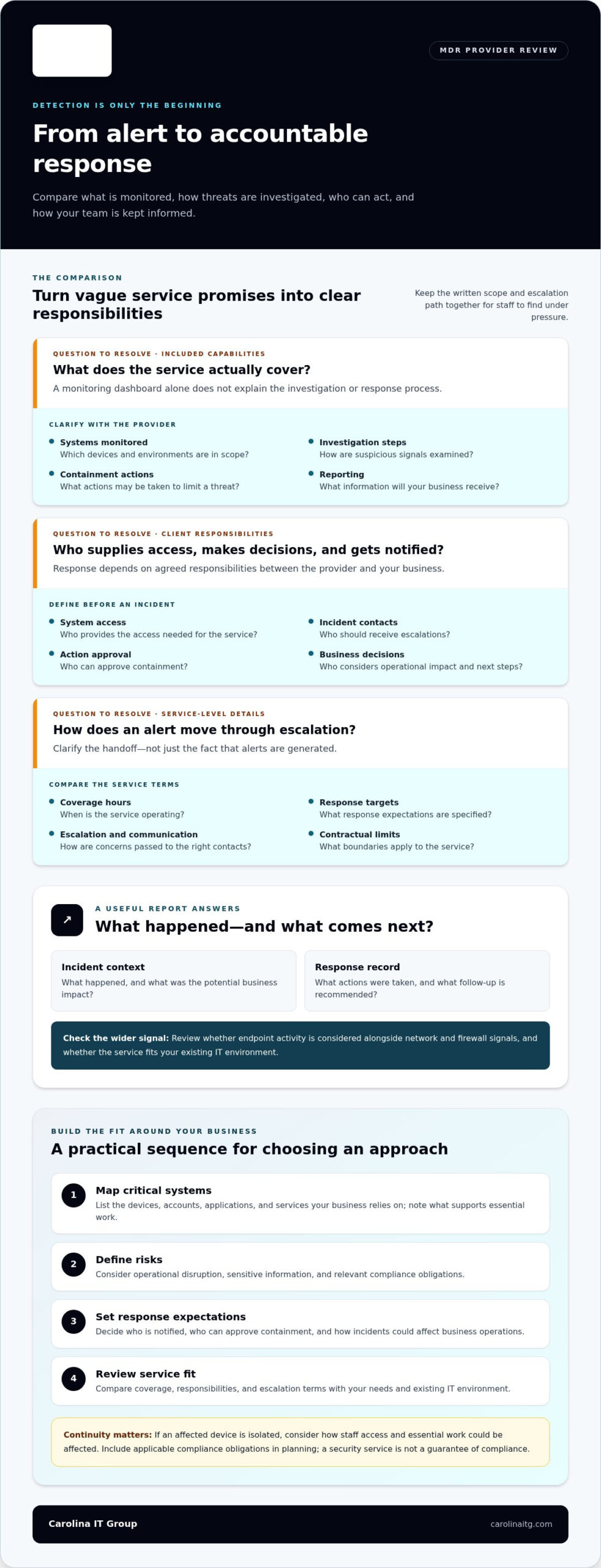
For businesses comparing managed detection and response (MDR) Raleigh services, look beyond the monitoring dashboard. Identify which systems are watched, how suspicious activity is investigated, who receives escalations, and who has authority to contain a threat. Clarify the handoff process: if a device is isolated or access is restricted, the right business and IT contacts need to know what happened, why the action was taken, and what comes next.
Which MDR service details should Raleigh businesses compare?
Look for reports that explain the incident, its potential business impact, actions taken, and recommended follow-up. Useful reporting gives leaders context, not just a list of alerts. Review whether the service considers endpoint activity alongside network and firewall signals, and how it fits with your existing IT environment. For a wider view of security planning, explore cybersecurity services.
| Area | Compare or clarify |
|---|---|
| Included capabilities | Systems monitored, investigation steps, containment actions, and reporting. |
| Client responsibilities | Who supplies system access, names incident contacts, approves actions, and handles business decisions. |
| Service-level details | Coverage hours, response targets, escalation steps, communication methods, and contractual limits. |
Keep the written scope and escalation path together so staff can find them under pressure. Carolina IT Group’s cybersecurity services include threat detection, firewall management, and endpoint protection, while managed IT support provides broader technology context. To discuss how security and IT needs fit together for your Raleigh business, share your business priorities.
Choosing an MDR approach for your Raleigh business
The right security approach starts with your business, not a tool. Before comparing managed detection and response (MDR) Raleigh options, map the systems that keep work moving: staff devices, key applications, network equipment, and important data. Then consider which threats could interrupt operations, how much security work your team can manage, and which response decisions may need to be made quickly.
- Map critical systems: List the devices, accounts, applications, and services your business relies on. Note which ones support essential work.
- Define risks: Consider likely operational disruption, sensitive information, and relevant compliance obligations.
- Set response expectations: Decide who should be notified, who can approve containment, and how incidents could affect business operations.
- Review service fit: Compare coverage, responsibilities, and escalation terms with your needs and existing IT environment.
Plan for continuity as well as detection. If an affected device must be isolated, for example, your team should understand how that could affect staff access and essential work. Include applicable compliance obligations in your planning, but don’t treat a security service as a guarantee of compliance. Security controls need to align with your organization’s actual responsibilities and processes.
How Carolina IT Group supports cybersecurity planning in North Carolina
Carolina IT Group helps businesses in Raleigh, Greenville, and Wilmington connect cybersecurity planning with the technology they use. Its capabilities include threat detection, firewall management, endpoint protection, security audits, and vulnerability assessments. Consider these alongside broader managed IT support services so security decisions account for day-to-day operations, not just individual alerts.
A practical next step for your Raleigh business is to outline critical systems, current concerns, and response priorities. Discuss your security needs with Carolina IT Group to connect your cybersecurity priorities with your wider IT environment.
Build a clearer path to stronger cybersecurity
Choosing managed detection and response (MDR) Raleigh services is about more than selecting security tools. Focus on what gets monitored, how suspicious activity is investigated, who can act, and how your team is kept informed. A clear view of critical systems, business risks, and response responsibilities can help you choose an approach that fits your operations.
Carolina IT Group supports North Carolina businesses, including those in Raleigh, Greenville, and Wilmington. Its cybersecurity capabilities include threat detection, firewall management, and endpoint protection, supporting a broader view of business technology and security needs.
Ready to discuss your priorities? Talk with Carolina IT Group about your cybersecurity needs.
Frequently Asked Questions
What is managed detection and response (MDR)?
MDR is a managed cybersecurity service that combines ongoing threat monitoring with investigation and response processes. Instead of relying only on software alerts, a business has a defined process for reviewing suspicious activity and escalating or responding to incidents. Systems covered, response authority, and service hours depend on the written scope, so review those details to understand what the service includes.
How is MDR different from EDR?
Endpoint detection and response (EDR) is technology that helps identify and investigate activity on computers and other endpoints. MDR is a managed service that may use EDR tools alongside people and processes for monitoring, investigation, escalation, and response. Compare more than product names: focus on which systems are covered, who reviews alerts, and what actions the service is responsible for taking.
Does a Raleigh business need MDR if it already has antivirus?
Not necessarily, but antivirus alone may not provide ongoing investigation or a coordinated response when suspicious activity appears. MDR may be worth evaluating if your team needs more monitoring and response capacity. Start by reviewing current protections, business risks, staff capacity, and the responsibilities a proposed service would cover. This helps identify gaps without assuming you need another layer.
What should I look for when comparing MDR providers in Raleigh?
When comparing managed detection and response (MDR) Raleigh options, review monitoring coverage, investigation methods, escalation contacts, response authority, reporting, and documented service hours. Clarify who acts during an incident and how the service coordinates with existing IT support. Businesses in Raleigh, Greenville, and Wilmington can compare the written scope with their systems and response needs.

President & CEO
I hope you enjoyed this article. My mission is to take your stress away from dealing with IT problems. Call (252) 565-1235 or send me a message at our contact us page if you have a question, comment or want help.



Leave a Reply
You must be logged in to post a comment.