What good is a penetration test if its final report leaves your team unsure what to fix first? Testing can reveal weaknesses, but those findings help only when they’re clear, prioritized, and connected to business risk.
If you’re comparing cybersecurity services Wilmington businesses can use to strengthen protection, it’s worth understanding what a penetration test covers, what it leaves out, and how its findings can guide practical next steps. This guide explains how to assess scope, interpret results, and compare reporting and remediation guidance without mistaking an automated scan for a hands-on assessment. You’ll also see how findings can inform a broader security plan, from vulnerability assessments and endpoint protection to continuity planning. Carolina IT Group provides cybersecurity and managed IT services for businesses in Wilmington, Raleigh, and Greenville, with an emphasis on ongoing protection rather than one-time fixes.
Key Takeaways
- Use a penetration test to examine agreed-upon systems, but treat its findings as a snapshot, not a promise of future security.
- Compare cybersecurity services Wilmington businesses consider by scope, authorization, business priorities, reporting, and remediation guidance.
- Rank findings by business impact and exposure so your team can focus on the most important fixes first.
- Build on test results with ongoing threat detection, firewall management, endpoint protection, and backups for broader resilience.
Cybersecurity Services in Wilmington: What a Penetration Test Should Reveal
A penetration test is an authorized, scoped assessment that looks for weaknesses in selected systems by examining how they might be misused. For businesses comparing cybersecurity services Wilmington options, scope is essential: a test may examine agreed applications, networks, systems, or access paths, but it does not automatically cover every part of your technology environment. Penetration Testing Explained offers a broader overview of common testing approaches and their purpose.
A useful report explains what was found, how the issue could affect the business, and what deserves attention. For example, an application weakness might expose sensitive customer or company information, while a path into an essential system could disrupt operations. Clear reporting translates technical findings into business terms, including the possible effect on customers and daily work.
A test is a point-in-time assessment, not a guarantee against future incidents. Systems change, new weaknesses emerge, and the test covers only the boundaries agreed upon. Use the results as evidence for security planning, not as a permanent all-clear.
What should a Wilmington business expect a penetration test to cover?
The scope should identify the systems, applications, networks, and access paths included, as well as any exclusions. It should also state the testing boundaries and require written authorization before work begins. These details help prevent activity from affecting systems outside the agreed scope and give everyone a shared understanding of what is permitted.
Penetration testing and vulnerability scanning are related, but they are not interchangeable. A scan checks selected assets for known weaknesses; a penetration test assesses whether weaknesses could be used to reach a meaningful business impact. Both can inform security decisions, but neither provides complete protection on its own. Wilmington businesses can connect security findings with managed IT support services as part of an ongoing protection plan.
How to Compare Penetration Testing Services in Wilmington
Start by matching the assessment to your business risks, not by comparing technical terms alone. For businesses weighing cybersecurity services Wilmington options, consider which systems matter most and what an incident involving them could interrupt. An online application that handles customer information may need a different focus from employee devices or a network supporting daily operations.
Read the scope carefully. It should say what will be examined, what is excluded, how testing is authorized, and how potential disruption will be managed. Compare proposals by their actual boundaries, methods, and deliverables rather than assuming they cover the same ground. IBM’s overview of penetration testing also explains how testing differs from vulnerability assessment.
Which questions help compare a cybersecurity assessment?
Use these criteria to judge whether an assessment is likely to produce findings your team can act on:
- Scope: Does it cover the systems and business risks you need to understand, with boundaries, exclusions, and written authorization clearly defined?
- Reporting: Will findings include supporting evidence, severity, likely business impact, and practical next steps, rather than a technical list alone?
- Priorities: Are issues ranked by urgency and potential harm, so your team can distinguish an exposed critical system from a lower-impact concern?
- Follow-through: Does the plan explain how to approach remediation and whether a follow-up check can confirm fixes, without suggesting that every risk can be eliminated?
A clear report helps decision-makers understand what to address first and why. Carolina IT Group’s cybersecurity services can support businesses connecting assessment findings with ongoing protection and IT support.
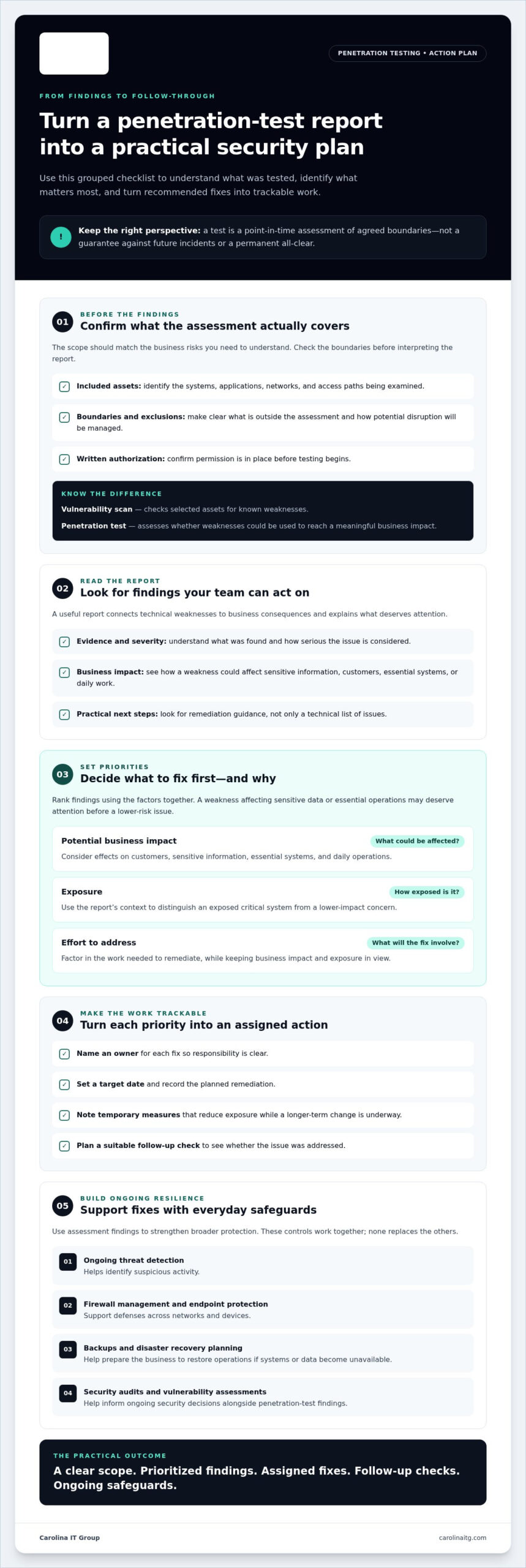
Turn Penetration-Test Findings into a Wilmington Cybersecurity Plan
A report is a starting point, not a work plan. Rank findings by potential business impact, how exposed the weakness is, and the effort needed to address it. A vulnerability affecting a system that handles sensitive data or supports essential operations may need attention before a lower-risk issue, even if both appear in the report.
Turn priorities into assigned actions. Name an owner for each fix, set a target date, and record any temporary measures that reduce exposure while a longer-term change is underway. After remediation, arrange a suitable follow-up check to see whether the issue was addressed. This turns the report into a set of trackable decisions rather than a document that sits unread.
What happens after the report is delivered?
Use the findings to strengthen everyday safeguards as well as address individual weaknesses. Ongoing threat detection can help identify suspicious activity; firewall management and endpoint protection support defenses across networks and devices. Backups and disaster recovery planning help prepare the business to restore operations if systems or data become unavailable. These controls work together, and none replaces the others.
For businesses in Wilmington, managed IT security supports ongoing protection through threat detection, firewall management, endpoint protection, security audits, and vulnerability assessments. Managed IT support can help align technical changes with business operations and continuity planning. Carolina IT Group provides cybersecurity and IT support for businesses in Wilmington, Raleigh, and Greenville, helping turn assessment insights into an ongoing protection plan rather than treating a single test as the whole strategy.
Make Your Next Security Step Count
A penetration test is most useful when its scope reflects real business priorities and its findings lead to clear, assigned remediation. Treat the results as a point-in-time view, then strengthen protection with ongoing security controls and continuity planning. That’s how cybersecurity services Wilmington businesses use can become part of a practical, sustained plan instead of a one-time exercise.
Carolina IT Group provides cybersecurity services that include threat detection, firewall management, endpoint protection, security audits, and vulnerability assessments. These safeguards can help businesses build on what their findings reveal and maintain protection over time.
Start with the risks that matter most to your operations, then plan the next steps with an IT partner. Discuss your Wilmington business’s cybersecurity needs with Carolina IT Group and move forward with a clearer, more practical plan.
Frequently Asked Questions
What does a penetration test include?
A penetration test examines agreed systems, applications, networks, or access paths for weaknesses that could affect the business. The scope should be authorized in writing and set clear boundaries before testing begins. The final report should explain what was found, why it matters, and which issues deserve attention first. For Wilmington businesses, the systems included depend on the risks and priorities being assessed.
How often should a business get a penetration test?
There’s no single testing schedule that fits every business. Consider reassessing after major technology changes, such as launching an application, changing network infrastructure, or adding systems that handle sensitive information. Your business’s risk, technology environment, and applicable requirements can also shape timing. Businesses in Wilmington, Raleigh, and Greenville should treat testing as one part of an ongoing security plan, not a substitute for routine protection.
Is penetration testing the same as a vulnerability scan?
No. A vulnerability scan checks selected systems for known security weaknesses, while a penetration test assesses whether weaknesses could be used to gain access or affect business operations. Scanning can help identify issues across systems, but it does not provide the same kind of hands-on assessment. Both approaches can offer useful information, depending on the question your business needs answered.
What should a business do after a penetration test?
Review the findings, prioritize them by business impact and exposure, then assign an owner and target date to each agreed fix. Track remediation and arrange a suitable follow-up check. Support the plan with ongoing safeguards such as threat detection, firewall management, endpoint protection, and reliable backups. These are key areas addressed by cybersecurity services Wilmington businesses can use to strengthen protection over time.

President & CEO
I hope you enjoyed this article. My mission is to take your stress away from dealing with IT problems. Call (252) 565-1235 or send me a message at our contact us page if you have a question, comment or want help.